Arduino Schematics
Arduino is an open-source electronics platform based on easy-to-use hardware and software. It is designed for anyone to use, regardless of their level of expertise in electronics. Arduino boards are commonly used for a wide range of projects, including building DIY devices, controlling home appliances, creating interactive art installations, and more. One of the key benefits of Arduino is its community-driven nature. There are a plethora of resources available online for those looking to learn more about Arduino or troubleshoot problems they may encounter while working on a project. Flux.ai has the world's largest community-driven public library of Arduino footprints, symbols, datasheets, and simulation models. This makes it an invaluable resource for those looking to take their Arduino projects to the next level. Whether you're a beginner or a seasoned pro, Flux.ai has something to offer.
PCA9685PW,118
LED Driver IC 16 Output Linear PWM Dimming 25mA 5.5V 28-TSSOP PCA9685PW,118 is a 16-channel, 12-bit PWM LED controller with an I²C interface designed for LED dimming, RGB/RGBA lighting, and servo motor control applications. It provides independent PWM control for up to 16 outputs, allowing precise brightness or position control while minimizing MCU GPIO usage. The device supports Fast-mode Plus I²C communication up to 1 MHz and operates from a 2.3 V to 5.5 V supply range. It is commonly used in robotics, LED backlighting, automation systems, and PWM expansion modules for microcontrollers such as Arduino, ESP32, and Raspberry Pi. Key Features 16 independent PWM output channels 12-bit PWM resolution (4096 steps) Programmable PWM frequency from approximately 24 Hz to 1526 Hz I²C Fast-mode Plus compatible interface up to 1 MHz Six hardware address pins allowing up to 62 devices on one I²C bus Programmable open-drain or totem-pole outputs Output capability: 25 mA sink current 10 mA source current Internal 25 MHz oscillator with optional external clock input Individual programmable LED ON/OFF timing for reduced EMI and current surges Supports software reset and group addressing (All Call/Sub Call) 5.5 V tolerant inputs and outputs Operating voltage range: 2.3 V to 5.5 V Package: 28-pin TSSOP (PW suffix) #CommonPartsLibrary #IntegratedCircuit #PowerManagement #LEDdriver
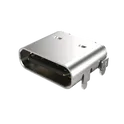
73 Uses1 StarsUSB4105-GF-A
USB-C (USB TYPE-C) USB 2.0 Receptacle Connector 24 (16+8 Dummy) Position Surface Mount, Right Angle; Through Hole The USB4105-GF-A is a USB Type-C receptacle connector designed for USB 2.0 applications, commonly used in embedded systems, IoT devices, and consumer electronics. It features a 24-position (16 active + 8 dummy) contact design that supports reversible plug orientation, making it user-friendly and compliant with USB Type-C standards. This connector is a right-angle, surface-mount (SMT) device with through-hole retention tabs, providing both compact PCB integration and strong mechanical stability. Key Features USB Type-C Interface Reversible plug orientation (no wrong insertion) Standard USB Type-C receptacle Supports USB 2.0 signaling Contact Configuration 24 pins total (16 active + 8 dummy pins) Includes: Power (VBUS) Ground (GND) USB 2.0 data (D+, D−) Configuration channel (CC) Electrical Capability Supports multiple current levels (up to 5A depending on design) Rated voltage up to 48V DC Mechanical Design Right-angle (horizontal) mounting Surface-mount + through-hole hybrid Includes: Board guide Solder retention tabs (strong anchoring) Durability & Materials Shielded metal shell (EMI protection) Contact finish: Gold plating Housing: UL94 V-0 flame rated Mating cycles: ~20,000 insertions Environmental Specs Operating temperature: -40°C to +85°C RoHS compliant (lead-free) Typical Applications Microcontroller boards (ESP32, Arduino, etc.) Charging + data interface for embedded devices Power + USB communication ports Consumer electronics (gadgets, accessories) #CommonPartsLibrary #Connector #USB #DVI #USB4105 #USB-C
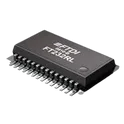
2.3k Uses1 StarsFT232RL
USB to Serial Interface, SSOP-28 FTDI USB Serial SSOP*5.3x10.2mm*P0.65mm* The FT232RL is a full-speed USB 2.0 to asynchronous serial data transfer IC. It integrates all the necessary USB protocol handling and UART interface logic, making it very easy to add USB connectivity to embedded devices without requiring complex firmware development. It is commonly used in development boards (like Arduino clones), USB-to-TTL converters, and debugging interfaces. Key Features USB Interface Fully compliant with USB 2.0 Full-Speed (12 Mbps) Integrated USB transceiver (no external components required) Supports USB suspend/resume modes Internal EEPROM for storing USB descriptors (no external EEPROM needed) Serial (UART) Interface Supports standard UART communication (TX, RX) Configurable baud rates from 300 bps up to 3 Mbps Supports hardware flow control (RTS/CTS, DTR/DSR) Bit-bang mode for simple GPIO control Integrated Components Built-in clock generator (no external crystal required) Internal EEPROM for configuration Integrated voltage regulator (3.3V output available for external use) Power Features Operates from 3.3V to 5V Can be powered directly from USB (bus-powered) Low power consumption with sleep mode Driver Support Virtual COM Port (VCP) drivers available for: Windows Linux macOS Also supports direct D2XX driver for advanced applications Package Typically available in SSOP-28 package Common Applications USB-to-serial converters (TTL/RS232) Microcontroller programming and debugging Embedded system communication Industrial and instrumentation interfaces
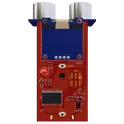
154 Uses1 StarsUltrasonic Distance Meter Reference Design
This circuit is an ultrasonic distance meter based on an ATTiny2313 microcontroller. It uses an HC-SR04 ultrasonic sensor to measure distance and displays the results on an OLED display. The power supply is constructed using a Boost converter (TPS613222A) and a 2-cell AA battery. Additionally, it also includes ISP for programming, RESET and START switches, and LED indicators. #project #Template #projectTemplate #ultrasonic #OLED #arduino #attiny2313 #TPS613222A #ISP #referenceDesign #simple-embedded #microchip #template #reference-design .
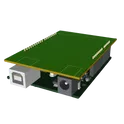
0 Uses1 StarsRFID
Template for Arduino Uno R3 Shield. Include an official pinout so you will always know Arduino names, the alternative roles of pins, which one is SDA, or SCL, etc. On PCB you can find the 3D model of the Arduino Uno R3 itself along with the board outline on the silkscreen. #Arduino #Uno #Shield #Template #project-template #project
0 Uses1 Stars
Arduino Pro Micro
The Micro is a microcontroller board based on the ATmega32U4 (datasheet), developed in conjunction with Adafruit. It has 20 digital input/output pins (of which 7 can be used as PWM outputs and 12 as analog inputs), a 16 MHz crystal oscillator, a micro USB connection, an ICSP header, and a reset button. It contains everything needed to support the microcontroller; simply connect it to a computer with a micro USB cable to get started. It has a form factor that enables it to be easily placed on a breadboard. The Micro board is similar to the Arduino Leonardo in that the ATmega32U4 has built-in USB communication, eliminating the need for a secondary processor. This allows the Micro to appear to a connected computer as a mouse and keyboard, in addition to a virtual (CDC) serial / COM port.
0 Uses1 StarsWily Orange TARDIS
Objetivo: leer coordenadas X/Y en un panel resistivo casero con Arduino Nano. Componentes: Arduino Nano, 16 MHz, 5 V (1x) MCP23017, expansor I/O I²C de 16 pines (1x) ADS1115, ADC I²C 16 bits (1x) Panel táctil casero, 2 láminas aluminio (1x) Resistencias serie 4.7 kΩ – 10 kΩ (4x) Fuente 5 V (USB/external) Funcionamiento: MCP23017 controla X+/X-/Y+/Y- → aplica 5 V y GND al eje activo. Ejemplo: para leer X → MCP energiza X+/X-, deja Y flotante. ADS1115 mide voltaje en el eje sin energía (ej: Y+/Y-) en modo diferencial. Arduino Nano recibe lecturas por I²C, procesa coordenadas X/Y. Coordenadas enviadas por USB serial al PC. Conexiones: Arduino Nano ↔ I²C bus ↔ MCP23017 y ADS1115 (SDA, SCL en común). MCP23017 pines → X+/X-/Y+/Y- (con resistencias serie). ADS1115 entradas analógicas → eje libre (Y+/Y- o X+/X- según ciclo). Alimentación común: 5 V + GND.
0 Uses1 StarsArduino Uno R3 Shield Template hvke
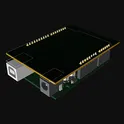
Template for Arduino Uno R3 Shield. Include an official pinout so you will always know Arduino names, the alternative roles of pins, which one is SDA, or SCL, etc. On PCB you can find the 3D model of the Arduino Uno R3 itself along with the board outline on the silkscreen. #Arduino #Uno #Shield #Template #project-template #project
0 Uses1 StarsUltrasonic Distance Meter Reference Design
This circuit is an ultrasonic distance meter based on an ATTiny2313 microcontroller. It uses an HC-SR04 ultrasonic sensor to measure distance and displays the results on an OLED display. The power supply is constructed using a Boost converter (TPS613222A) and a 2-cell AA battery. Additionally, it also includes ISP for programming, RESET and START switches, and LED indicators. #project #Template #projectTemplate #ultrasonic #OLED #arduino #attiny2313 #TPS613222A #ISP #referenceDesign #simple-embedded #microchip #template #reference-design
0 Uses1 StarsArduino Nano Shield Template 9f6G
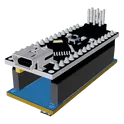
Template for Arduino Nano Shield. Include an official pinout so you will always know Arduino names, the alternative roles of pins, which one is SDA, or SCL, etc. On PCB you can find the 3D model of the Arduino Nano itself along with the board outline on the silkscreen. #Arduino #Nano #Shield #template #project #project-template
0 Uses1 StarsArduino Nano Shield Template
Template for Arduino Nano Shield. Include an official pinout so you will always know Arduino names, the alternative roles of pins, which one is SDA, or SCL, etc. On PCB you can find the 3D model of the Arduino Nano itself along with the board outline on the silkscreen. #Arduino #Nano #Shield #template #project #project-template
0 Uses1 StarsArduino Uno R3 Shield Max485 single
Template for Arduino Uno R3 Shield. Include an official pinout so you will always know Arduino names, the alternative roles of pins, which one is SDA, or SCL, etc. On PCB you can find the 3D model of the Arduino Uno R3 itself along with the board outline on the silkscreen. #Arduino #Uno #Shield #Template #project-template #project
0 Uses1 Stars
ESP_from_Chaina
NodeMCU V3 ESP8266 ESP-12E is WiFi development board that helps you to prototype your IoT product with few Lua script lines, or through Arduino IDE. The board is based on ESP8266 ESP-12E variant, unlike other ESP-12E, you won’t need to buy a separate breakout board, usb to serial adapter, or even solder it to a PCB to get started, you will only need a usb cable (Micro USB).
0 Uses1 Starsarduino uno
Learn how to use AI Auto Layout on this ESP32 Espresso Smart Scale! In one click you’ll see AI Auto Layout perform magic. Pay close attention to how we recommend creating rulesets, zones, and fanouts. By copying the setup in this example on your own project, you’ll have a fully routed board in no time!
0 Uses1 StarsESP_from_Chaina
NodeMCU V3 ESP8266 ESP-12E is WiFi development board that helps you to prototype your IoT product with few Lua script lines, or through Arduino IDE. The board is based on ESP8266 ESP-12E variant, unlike other ESP-12E, you won’t need to buy a separate breakout board, usb to serial adapter, or even solder it to a PCB to get started, you will only need a usb cable (Micro USB).
0 Uses1 StarsArduino Uno R3 Shield Template
Template for Arduino Uno R3 Shield. Include an official pinout so you will always know Arduino names, the alternative roles of pins, which one is SDA, or SCL, etc. On PCB you can find the 3D model of the Arduino Uno R3 itself along with the board outline on the silkscreen. #Arduino #Uno #Shield #Template #project-template #project
0 Uses1 Stars
![[Example] Arduino MKR Shield Template](https://img-cdn.flux.ai/eyJidWNrZXQiOiJncmF2aXRvbi1lbGVjdHJpYy1zeW1ib2xzIiwia2V5IjoiZG9jdW1lbnRfYXNzZXRzL2FyZHVpbm8tbWtyLXplcm8tN2YwZjE0YzQtNGE0My00ZjJkLWE1MzUtNWE2Y2RlZmY2NDYxLnBuZyIsImVkaXRzIjp7InJlc2l6ZSI6eyJ3aWR0aCI6MTI0LCJoZWlnaHQiOjEyNCwiZml0IjoiY29udGFpbiIsImJhY2tncm91bmQiOnsiciI6MCwiZyI6MCwiYiI6MCwiYWxwaGEiOjB9fX0sIm91dHB1dEZvcm1hdCI6IndlYnAifQ==)