Arduino Schematics
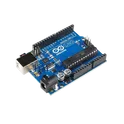
Arduino is an open-source electronics platform based on easy-to-use hardware and software. It is designed for anyone to use, regardless of their level of expertise in electronics. Arduino boards are commonly used for a wide range of projects, including building DIY devices, controlling home appliances, creating interactive art installations, and more. One of the key benefits of Arduino is its community-driven nature. There are a plethora of resources available online for those looking to learn more about Arduino or troubleshoot problems they may encounter while working on a project. Flux.ai has the world's largest community-driven public library of Arduino footprints, symbols, datasheets, and simulation models. This makes it an invaluable resource for those looking to take their Arduino projects to the next level. Whether you're a beginner or a seasoned pro, Flux.ai has something to offer.
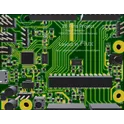
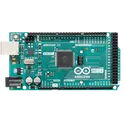
Arduino ATMEGA2560-16AU Template
Arduino Template based on ATMEGA2560-16AU. This MCU is used in Arduino Mega2560, Arduino Arduino Mega ADK, and some other. This template is a good starting point for your Arduino based project. #Arduino #mega #2560 #ATMEGA2560 #template #project #project-template
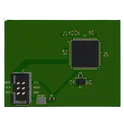
0 Uses2 StarsKeypad lock Module
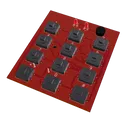
This module involves the design of a keypad lock system. It utilizes an ATMEGA328P microcontroller, buzzers, LEDs for indicator functions and a 4x3 matrix keypad. An in-circuit serial programming (ISP) header is also present for programming the microcontroller. #template #lock #keypad #reusable #module #simple-embedded #microchip #arduino #atmega328 #TPS613222A #ISP #buzzer #sublayout
222 Uses2 StarsBlues - Swan Feather 3.0
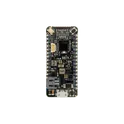
Feather-compatible dev board, powered by an STM32L4+ @ 120 MHz with 2MB of Flash and 640KB of RAM Expandable to 55 pins for access to additional I/O and buses Plenty of Flash and RAM for edge ML workloads or complex applications Support for C/C++, Arduino, and CircuitPython CORTEX Debug connector, enabling the use of Visual Studio Code, IAR, and STM32CubeIDE with optional SWD programmer #blues
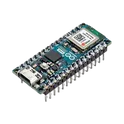
99 Uses2 StarsArduino Multipurpose PCB
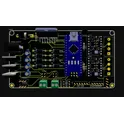
This is the multipurpose PCB that works with Arduino Nano, a way that you can run 2 Stepper motors, 2 DC motors, 2 Servo motors at the same time and this is not it you can even connect BT module, rotary encoder, I2C device, potentiometer at same time. This PCB is very much helpful in building any project and no need to worry about messy wire connections.
0 Uses2 StarsAaduino
The AAduino is an wireless Arduino clone the size of an AA battery with Keystone battery terminals rotated 180° to act as positive and negative terminals. It is meant to go inside a 3xAA battery holder creating a very small wireless node. Powered by an ATMega328p, it is fitted with an RFM69CW companion, two DS18B20 temperature sensors and an indicator LED
0 Uses2 Stars-59934b57-113a-1922-4834-67d18f6a5aae.svg)
Autonomous "Follow Me" Cooler
An Arduino Uno powers this autonomous “follow me” cooler that connects to a smartphone via Bluetooth and uses GPS to navigate. The robot cooler connects to a smartphone via Bluetooth and uses GPS to navigate. All the electronics will be contained in the base so that other objects can be carried as well. The electronics were installed in the box cutout under the platform. An Arduino Uno and a 5v battery to power the sensors, Bluetooth, and control logic. A 3s LiPo battery was used to power the motors. A HC-05 Bluetooth module was mounted at the front of the platform for better range. The rest of the components including a L298N motor driver, PAM-7Q GPS, and HMC6883L compass were mounted inside and connected to the Arduino through the breadboard. The compass works with I2C, so we connected the SLC and SDA pins to A5 and A4 respectively. The rest of the pins were connected through digital I/O.
0 Uses2 StarsBME280
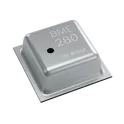
Humidity, Pressure, Temperature 0 ~ 100% RH I²C, SPI ±3% 1 s Surface Mount BME280 I2C breakout module The BME280 integrates three sensors—temperature, relative humidity, and pressure—along with a high-performance digital interface. It communicates via I²C or SPI, making it easy to interface with microcontrollers like Arduino, ESP32, and STM32. It is designed for low power consumption, making it suitable for battery-powered applications such as portable weather stations and smart home devices. Key Features Environmental Sensing Measures: Temperature Relative Humidity Barometric Pressure Enables altitude estimation based on pressure readings High Accuracy Temperature: ±1.0°C (typical) Humidity: ±3% RH (typical) Pressure: ±1 hPa (typical) Low Power Consumption Typical current: ~0.6 µA (sleep mode) ~3.6 µA (measurement mode) Ideal for battery-operated devices Communication Interfaces Supports: I²C (up to 3.4 MHz) SPI (3-wire / 4-wire) Easy integration with most microcontrollers Compact Package Small footprint: 2.5 × 2.5 × 0.93 mm LGA package Suitable for space-constrained designs Built-in Features Factory-calibrated coefficients stored in NVM Configurable oversampling and filtering Integrated ADC for high-resolution measurements #commonpartslibrary #sensor #humidity #pressure
318 Uses1 Stars2.54-2*20
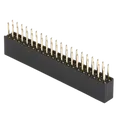
Female Headers CONN SOCKET 40POS 2.54mm DUAL ROW TH This connector consists of 40 pins total (2 rows × 20 pins) spaced at 2.54 mm pitch. It is widely used in PCB interconnections, embedded systems, Raspberry Pi-style GPIO headers, Arduino expansion boards, and general prototyping applications. It mates with standard female headers or jumper wires. Key Features Pin configuration: 2×20 (40 pins total) Pitch: 2.54 mm (0.1 inch standard) Mounting type: Through-hole (THT) Orientation options: Vertical or right-angle variants Contact material: Typically brass or phosphor bronze Plating: Tin or gold-plated options for improved conductivity Current rating: Commonly 1A–3A per pin (depends on manufacturer) Voltage rating: Typically up to 250V AC/DC (application-dependent) Compatibility: Standard 2.54 mm female headers and jumper cables Use cases: Development boards, GPIO expansion, debugging interfaces, mezzanine connections #CommonPartsLibrary #Connector
249 Uses1 Stars