Resistors
A resistor is an electronic component that reduces the flow of current in a circuit. It is used to limit the amount of current flowing through a circuit, or to create a voltage drop in a circuit. One of the main uses of resistors is to protect components from too much current, which can cause damage or failure. Flux.ai is the world's largest community-driven public library of resistors, with footprints, symbols, datasheets, and simulation models. Whether you're an engineer working on a new design, or a student learning about electronics, Flux.ai is the go-to resource for all things resistor-related. With a wealth of information and resources available, you'll find everything you need to know about resistors, and more.
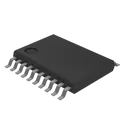
TXS0108EPWR
Voltage Level Translator Bidirectional 1 Circuit 8 Channel 60Mbps 20-TSSOP This device is an 8-bit non-inverting level translator which uses two separate configurable power-supply rails. The A port tracks the VCCA pin supply voltage. The VCCA pin accepts any supply voltage between 1.4V and 3.6V. The B port tracks the VCCB pin supply voltage. The VCCB pin accepts any supply voltage between 1.65V and 5.5V. Two input supply pins allows for low Voltage bidirectional translation between any of the 1.5V, 1.8V, 2.5V, 3.3V, and 5V voltage nodes. When the output-enable (OE) input is low, all outputs are placed in the high-impedance (Hi-Z) state. To put the device in the Hi-Z state during power-up or power-down periods, tie OE to GND through a pulldown resistor. The current-sourcing capability of the driver determines the minimum value of the resistor. • No direction-control signal needed • Maximum data rates: – 110Mbps (push pull) – 1.2Mbps (open drain) • 1.4V to 3.6V on A port and 1.65V to 5.5V on B port (VCCA ≤ VCCB) • No power-supply sequencing required – either VCCA or VCCB can be ramped first • Latch-up performance exceeds 100mA per JESD 78, class II • ESD protection exceeds JESD 22 (A port): – 2000 V Human Body Model (A114-B) – 150 V Machine Model (A115-A) – 1000 V Charged-Device Model (C101) • IEC 61000-4-2 ESD (B-port): – ± 8kV Contact Discharge – ± 6kV Air Discharge #commonpartslibrary #integratedcircuit #logic #translator #levelshifter
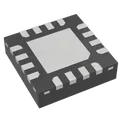
359 Uses1 StarsHUSB238A-BB001-QN16R
The HUSB238A is a highly integratedstand-aloneUSB Type-C® and Power Delivery (PD) Sinkcontroller.The HUSB238A integrates the CClogic, USBPDprotocol and the legacy protocols. The HUSB238A can run in I2C mode andGPIOmode.In I2C mode, an I2C master can access theHUSB238Ato configure settings, read back status andperformadvanced functions such as DRSwap, VDMmessages. The HUSB238A supports APDO, maximum48 V/5 A EPR FPDO and EPR AVSin I2Cmode. While in GPIO mode, the configuration is achievedviathe setting pins. The HUSB238A can beconfiguredtosupport maximum 28 V/3.25 A PDOviaVSETandISET pins, only two resistors are usedtoset thevoltage and current. The ultra-low operation current of theHUSB238Ahelps the system to reduce the total power dissipationand suitable for a battery application. The HUSB238A is available in QFN3 mmx3mm-16Lpackage. Fully Autonomous USB Type-C® and USB PD Sink Controller USB Type-C® Specification Reversion 2.1 and USB PD Specification Reversion 3.1 Supported Maximum 48 V/5 A PDO Supported – GPIO Mode: Maximum 28 V/3.25 A EPR FPDO and EPR AVS – I2C Mode: Maximum 48 V/5 A EPR FPDO, EPR AVS and SPR PPS Automatic Legacy Protocols Detection Including BC1.2, Divider 3, QC2.0 Support SOP’ Detection Typical Low Power Operation: IVDD< 75 μA Integrated VBUS Switch Driver Dead Battery Support VBUS Over-voltage Protection (OVP) and Under-voltage Protection (UVP) Over-temperature Protection (OTP) with Programmable Thresholds 2 kV HBM ESD Rating for USB IO Pins Small Package, 16 Lead QFN (3 mm x 3 mm) #CommonPartsLibrary #IntegratedCircuit #PowerManagement
100 Uses1 Stars