Oscillators
An oscillator is an electronic circuit that generates a periodic, oscillating signal, often a sine wave or a square wave. Oscillators are used in a wide range of applications, including clocks, radios, and sound synthesis. Flux.ai has the world's largest community-driven public library of oscillators, with footprints, symbols, datasheets, and simulation models. This comprehensive resource allows engineers and designers to easily find the oscillator they need for their specific application and use it with confidence. Whether you are working on a simple clock circuit or a complex radio transmitter, Flux.ai's oscillator library has you covered. So, if you are in need of an oscillator for your next project, be sure to check out Flux.ai's extensive collection.
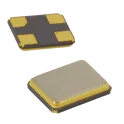
NX3225SA-26MHz-STD-CSR-6
The NX3225SA-26MHz-STD-CSR-6 is a surface-mount quartz crystal resonator designed to provide a stable frequency reference for microcontrollers, wireless communication modules, embedded systems, consumer electronics, industrial controls, and timing applications. Manufactured in a compact ceramic package, this crystal offers excellent frequency stability, low power consumption, and reliable long-term performance. Its standard frequency tolerance and stability characteristics make it suitable for clock generation, frequency synthesis, and synchronization functions in a wide range of electronic designs requiring precise timing accuracy. Features Surface-mount quartz crystal resonator Fundamental mode operation Compact ceramic package suitable for high-density PCB layouts Stable frequency reference for digital and RF applications Low equivalent series resistance for reliable oscillator startup Compatible with automated assembly processes Excellent aging characteristics and long-term reliability Suitable for low-power and battery-operated devices RoHS-compliant and lead-free construction Applications Microcontroller clock generation Wireless communication modules Bluetooth and Wi-Fi devices Industrial automation equipment IoT and smart devices Consumer electronics Measurement and instrumentation systems Embedded control platforms Timing and synchronization circuits Electrical Characteristics Nominal frequency centered at twenty-six megahertz Standard frequency tolerance classification Standard operating temperature stability Fundamental crystal oscillation mode Specified load capacitance configuration Low equivalent series resistance High insulation resistance Low drive level operation Reliable startup characteristics Long operational lifetime with minimal frequency drift Mechanical Characteristics Ceramic surface-mount package Compact footprint suitable for space-constrained designs Metal lid sealed construction Designed for reflow soldering processes Tape-and-reel packaging compatibility Environmental Characteristics Industrial-grade reliability Resistance to mechanical shock and vibration within specification limits Moisture-resistant sealed package construction Suitable for standard electronic manufacturing environments Compliant with environmental and hazardous substance regulations #commonpartslibrary #crystal #quartzcrystal #frequencyreference #timingdevice #oscillator #clocksource #smtcomponent #passivecomponent #embeddedsystems #wirelesscommunication #industrialelectronics #consumerelectronics #iotdevices #electronicsdesign
31 Uses0 StarsPCA9685PW,118
LED Driver IC 16 Output Linear PWM Dimming 25mA 28-TSSOP The PCA9685 is an I2C-bus controlled 16-channel LED controller optimized for Red/Green/Blue/Amber (RGBA) color backlighting applications. Each LED output has its own 12-bit resolution (4096 steps) fixed frequency individual PWM controller that operates at a programmable frequency from a typical of 24 Hz to 1526 Hz with a duty cycle that is adjustable from 0 % to 100 % to allow the LED to be set to a specific brightness value. All outputs are set to the same PWM frequency. Each LED output can be off or on (no PWM control), or set at its individual PWM controller value. The LED output driver is programmed to be either open-drain with a 25 mA current sink capability at 5 V or totem pole with a 25 mA sink, 10 mA source capability at 5 V. The PCA9685 operates with a supply voltage range of 2.3 V to 5.5 V and the inputs and outputs are 5.5 V tolerant. LEDs can be directly connected to the LED output (up to 25 mA, 5.5 V) or controlled with external drivers and a minimum amount of discrete components for larger current or higher voltage LEDs. The PCA9685 is in the new Fast-mode Plus (Fm+) family. Fm+ devices offer higher frequency (up to 1 MHz) and more densely populated bus operation (up to 4000 pF). Although the PCA9635 and PCA9685 have many similar features, the PCA9685 has some unique features that make it more suitable for applications such as LCD or LED backlighting and Ambilight: • The PCA9685 allows staggered LED output on and off times to minimize current surges. The on and off time delay is independently programmable for each of the 16 channels. This feature is not available in PCA9635. • The PCA9685 has 4096 steps (12-bit PWM) of individual LED brightness control. The PCA9635 has only 256 steps (8-bit PWM). • When multiple LED controllers are incorporated in a system, the PWM pulse widths between multiple devices may differ if PCA9635s are used. The PCA9685 has a programmable prescaler to adjust the PWM pulse widths of multiple devices. • The PCA9685 has an external clock input pin that will accept user-supplied clock (50 MHz max.) in place of the internal 25 MHz oscillator. This feature allows synchronization of multiple devices. The PCA9635 does not have external clock input feature. • Like the PCA9635, PCA9685 also has a built-in oscillator for the PWM control. However, the frequency used for PWM control in the PCA9685 is adjustable from about 24 Hz to 1526 Hz as compared to the typical 97.6 kHz frequency of the PCA9635. This allows the use of PCA9685 with external power supply controllers. All bits are set at the same frequency. • The Power-On Reset (POR) default state of LEDn output pins is LOW in the case of PCA9685. It is HIGH for PCA9635. #CommonPartsLibrary #IntegratedCircuit #PowerManagement
187 Uses0 StarsNX3225GD-8MHZ-STD-CRA-3
CRYSTAL 8MHz 8pF SMD The NX3225GD-8MHZ-STD-CRA-3 is an automotive-grade surface-mount quartz crystal unit from NDK designed to provide a stable 8 MHz clock reference for microcontrollers, automotive ECUs, and embedded systems. It belongs to the NX3225GD series and is optimized for high reliability under harsh environmental conditions. Key Features 8 MHz fundamental-mode crystal Compact 3.2 mm × 2.5 mm × 1.0 mm SMD package 8 pF load capacitance ±50 ppm frequency tolerance ±150 ppm frequency stability over temperature Automotive-qualified with AEC-Q200 compliance Wide operating temperature range: −40°C to +150°C Excellent resistance to heat, vibration, shock, and solder cracking Stable startup characteristics in severe environments RoHS compliant Typical Applications Automotive engine control units (ECUs) MCU and CPU clock generation Industrial embedded systems Communication equipment Consumer electronics and IoT devices #CommonPartsLibrary #crystal oscillator #resonator
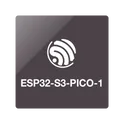
265 Uses0 StarsESP32-S3-PICO-1-N8R8
The ESP32-S3-PICO-1-N8R8 is a highly integrated System-in-Package (SiP) module from Espressif based on the ESP32-S3 SoC. It is designed for compact, low-power IoT applications requiring strong wireless performance, rich peripherals, and minimal external components. This variant (N8R8) integrates 8 MB of SPI flash and 8 MB of PSRAM, making it suitable for memory-intensive applications such as AIoT, voice processing, and graphical user interfaces. The module integrates RF circuitry, crystal oscillator, power management, and memory into a single package, significantly reducing PCB size and BOM cost while improving reliability. ⚡ Key Features Processor & Performance Dual-core Xtensa LX7 microprocessor Up to 240 MHz clock speed Hardware acceleration for AI/ML and vector operations Memory 8 MB SPI Flash 8 MB PSRAM Internal SRAM for fast access tasks Wireless Connectivity 2.4 GHz Wi-Fi 802.11 b/g/n Bluetooth 5 (LE) support Integrated RF front-end Peripherals GPIO, SPI, I2C, UART, ADC, PWM USB 1.1 OTG support RMT, I2S, SD/MMC interface Touch sensor support Power & Efficiency Low-power sleep modes for battery-powered devices Integrated power management circuitry (SiP-level integration) Wide operating voltage: 3.0V – 3.6V Integration Advantages Built-in crystal oscillator Integrated RF matching components Reduced external component count (SiP design) Compact footprint for space-constrained designs 📌 Typical Applications Smart home devices IoT sensors and controllers Voice-enabled AI devices Wearables HMI (Human Machine Interface) Industrial monitoring systems
4 Uses0 Stars