Sensors
A sensor is a device that detects and measures a physical property or phenomenon, such as temperature, pressure, or motion. Sensors are used in a wide range of applications, including industrial automation, environmental monitoring, healthcare, and transportation. Flux.ai is the world's largest community-driven public library of sensors, with footprints, symbols, datasheets, and simulation models. Our extensive collection of sensors covers a variety of use cases and industries, making it easy to find the perfect sensor for your application. Whether you need a temperature sensor for HVAC systems, a pressure sensor for automotive applications, or a motion sensor for security systems, Flux.ai has you covered. Our comprehensive library of sensors is constantly updated with the latest and most innovative technologies, ensuring that you have access to the best sensors available. So, if you need a sensor for your next project, be sure to check out Flux.ai and take advantage of our extensive collection and expert support.
ADXL335BCPZ-RL7
Accelerometer X, Y, Z Axis ±3g 1.6kHz (X,Y), 550Hz (Z) 16-LFCSP-LQ (4x4) The ADXL335BCPZ-RL7 is a low-power, complete 3-axis accelerometer with analog voltage outputs proportional to acceleration. It measures acceleration along the X, Y, and Z axes with a full-scale range of ±3 g. This device integrates a micro-electromechanical system (MEMS) sensor with signal conditioning circuitry, enabling direct analog output without the need for external amplification. The RL7 suffix indicates tape-and-reel packaging for automated assembly. The ADXL335BCPZ-RL7 is designed for compact, battery-powered, and motion-sensitive applications where low power consumption and ease of integration are critical. Functional Overview The accelerometer operates using a capacitive sensing structure. Acceleration causes displacement of an internal mass, changing capacitance, which is converted into a proportional analog voltage output. Each axis operates independently and provides a continuous analog signal that can be read by a microcontroller’s ADC. External capacitors allow the user to configure bandwidth per axis, enabling optimization for noise or response speed. Electrical Characteristics Supply Voltage Range: 1.8 V to 3.6 V Supply Current: Typical: 350 µA Measurement Range: ±3 g Sensitivity (Typical): 300 mV/g Zero-g Bias Level: Approximately VCC / 2 Bandwidth: Adjustable via external capacitors Typical limits: X, Y axes: up to 1600 Hz Z axis: up to 550 Hz Output Characteristics Output Type: Analog (ratiometric to supply voltage) Axes: Three independent outputs (XOUT, YOUT, ZOUT) Output Impedance: Approximately 32 kΩ Noise Density: X/Y axes: ~150 µg/√Hz Z axis: ~300 µg/√Hz Mechanical Characteristics Package Type: 16-lead LFCSP Package Dimensions: Approximately 4 mm × 4 mm × 1.45 mm Mounting: Surface mount Packaging Option: Tape and reel (RL7) Environmental Specifications Operating Temperature Range: −40°C to +85°C Storage Temperature Range: −65°C to +150°C Shock Survival: Up to 10,000 g Interface Requirements External Components: Capacitors required for bandwidth selection (one per axis) Interface Type: Analog voltage outputs compatible with ADC inputs Pin Description (Summary) ST: Self-test input XOUT: X-axis analog output YOUT: Y-axis analog output ZOUT: Z-axis analog output VCC: Power supply GND: Ground NC: No connection / reserved Applications Tilt and orientation sensing Motion and vibration detection Portable electronics Gaming controllers Wearable devices Industrial monitoring systems Key Features Three-axis acceleration measurement Low power consumption Analog output for simple interfacing Compact MEMS package Adjustable bandwidth Wide temperature operating range Tape-and-reel packaging for automated manufacturing #commonpartslibrary #integratedcircuit #sensor #accelerometer
2 Uses0 StarsADXL345BCCZ
Accelerometer X, Y, Z Axis ±2g, 4g, 8g, 16g 0.05Hz ~ 1.6kHz 14-LGA (3x5) The ADXL345 is a small, thin, ultralow power, 3-axis accelerometer with high resolution (13-bit) measurement at up to ±16 g. Digital output data is formatted as 16-bit twos complement and is accessible through either a SPI (3- or 4-wire) or I2C digital interface. The ADXL345 is well suited for mobile device applications. It measures the static acceleration of gravity in tilt-sensing applications, as well as dynamic acceleration resulting from motion or shock. Its high resolution (3.9 mg/LSB) enables measurement of inclination changes less than 1.0°. Several special sensing functions are provided. Activity and inactivity sensing detect the presence or lack of motion by comparing the acceleration on any axis with user-set thresholds. Tap sensing detects single and double taps in any direction. Free-fall sensing detects if the device is falling. These functions can be mapped individually to either of two interrupt output pins. An integrated memory management system with a 32-level first in, first out (FIFO) buffer can be used to store data to minimize host processor activity and lower overall system power consumption. Low power modes enable intelligent motion-based power management with threshold sensing and active acceleration measurement at extremely low power dissipation. The ADXL345 is supplied in a small, thin, 3 mm × 5 mm × 1 mm, 14-lead, plastic package. ► Ultralow power: as low as 23 µA in measurement mode and 0.1 µA in standby mode at VS = 2.5 V (typical) ► Power consumption scales automatically with bandwidth ► User-selectable resolution ► Fixed 10-bit resolution ► Full resolution, where resolution increases with g range, up to 13-bit resolution at ±16 g (maintaining 4 mg/LSB scale factor in all g ranges) ► Embedded memory management system with FIFO technology minimizes host processor load ► Single tap/double tap detection ► Activity/inactivity monitoring ► Free-fall detection ► Supply voltage range: 2.0 V to 3.6 V ► I/O voltage range: 1.7 V to VS ► SPI (3- and 4-wire) and I2C digital interfaces ► Flexible interrupt modes mappable to either interrupt pin ► Measurement ranges selectable via serial command ► Bandwidth selectable via serial command ► Wide temperature range (−40°C to +85°C) ► 10,000 g shock survival ► Pb free/RoHS compliant #CommonPartsLibrary #IntegratedCircuit #Sensor #Transducer #Motion-Sensor #Accelerometer #ADXL345
56 Uses0 StarsTLV75533PDBVR
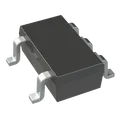
Linear Voltage Regulator IC Positive Fixed 1 Output 500mA SOT-23-5 The TLV75533PDBVR is a low-dropout (LDO) linear voltage regulator designed to provide a stable 3.3 V output from a higher input voltage source. It features ultra-low quiescent current and high power-supply rejection ratio (PSRR), making it ideal for battery-powered and noise-sensitive applications such as IoT devices, portable electronics, and RF circuits. The device is optimized for fast transient response and stable operation with small ceramic output capacitors. Key Features Fixed output voltage: 3.3 V Low dropout voltage (typ. ~200 mV at full load) Ultra-low quiescent current (typ. 25 µA) High PSRR for noise-sensitive applications Stable with small ceramic capacitors (≥1 µF) Thermal shutdown and overcurrent protection Available in compact SOT-23-5 package (DBV) Absolute Maximum Ratings Input voltage: –0.3 V to 6.5 V Output voltage: –0.3 V to (VIN + 0.3 V) Operating junction temperature: –40°C to +125°C Storage temperature range: –65°C to +150°C Recommended Operating Conditions Input voltage range: 1.45 V to 5.5 V Output voltage: 3.3 V (fixed) Output current: up to 500 mA Operating temperature range: –40°C to +125°C Electrical Characteristics (Typical unless otherwise noted) Output voltage accuracy: ±1% Dropout voltage: ~200 mV @ 500 mA Quiescent current: ~25 µA PSRR: up to 70 dB (at 1 kHz) Line regulation: <0.05%/V Load regulation: <0.5% Pin Configuration (SOT-23-5) Pin 1: IN – Input voltage Pin 2: GND – Ground Pin 3: EN – Enable (active high) Pin 4: NC – No connect Pin 5: OUT – Regulated output Typical Application Power management for microcontrollers and sensors Battery-powered portable devices RF and analog circuits requiring low noise supply IoT and wearable electronics Protection Features Thermal shutdown protection Overcurrent protection Undervoltage lockout (UVLO) #commonpartsLibrary #integratedcircuit #powermanagement #voltageregulator
472 Uses0 StarsLP2985IM5-2.7
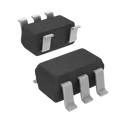
Linear Voltage Regulator IC Positive Fixed 1 Output 150mA SOT-23-5 LP2985IM5-2.7 is a low-dropout (LDO) linear voltage regulator designed to provide a stable 2.7 V output with very low quiescent current and excellent noise performance. It is optimized for battery-powered and noise-sensitive applications, offering high power supply rejection ratio (PSRR) and fast transient response. The device is housed in a compact SOT-23-5 package, making it ideal for space-constrained designs. Key Features Fixed 2.7 V output voltage Low dropout voltage Low quiescent current (IQ) High PSRR for noise-sensitive applications Stable with low ESR ceramic capacitors Thermal shutdown and current limit protection Small SOT-23-5 package RoHS compliant Electrical Characteristics Output Voltage: 2.7 V (fixed) Output Voltage Accuracy: ±1.5% (typical) Maximum Output Current: 150 mA Dropout Voltage: ~280 mV at 150 mA (typical) Quiescent Current (IQ): ~65 µA (typical) Line Regulation: 0.04%/V (typical) Load Regulation: 0.2% (typical) PSRR: Up to 70 dB (at low frequency) Operating Input Voltage Range: 2.5 V to 16 V Operating Temperature Range: -40°C to +125°C Mechanical Characteristics Package Type: SOT-23-5 (DBV) Mounting Type: Surface Mount Pin Count: 5 pins Approximate Dimensions: 2.9 mm × 1.6 mm Pin Configuration (Typical) IN: Input voltage GND: Ground OUT: Regulated output (2.7 V) EN: Enable (active high) BYPASS: Noise reduction / bypass capacitor connection Performance Characteristics Excellent output noise performance (low-noise design) Fast transient response to load changes Stable with small ceramic capacitors (typically 1 µF) Suitable for RF and analog circuits Applications Battery-powered devices Portable electronics RF and wireless modules Sensors and analog circuits Microcontroller power supplies #CommonPartsLibrary #IntegratedCircuit #PowerManagement #voltage-regulator #LDO #LP3985
2 Uses0 StarsSDP33-1500Pa-TR-250pcs
Pressure Sensor +/-0.22PSI (+/-1.5kPa) Differential Male - 0.08\" (2.00mm) Tube, Dual 16 b 16-SMD Module, Dual Top Ports The SDP33-1500Pa-TR-250PCS is a digital differential pressure sensor module from Sensirion AG, designed for high-precision measurement of low-pressure differences up to ±1500 Pa (±1.5 kPa). It belongs to the SDP3x series, which uses Sensirion’s CMOSens® technology for compact, accurate, and stable sensing performance. It is widely used in HVAC systems, airflow measurement, medical devices, and industrial control applications where precise air or gas flow monitoring is required. Key Features Differential Pressure Measurement Range: ±1500 Pa (±1.5 kPa) Digital Output Interface I²C communication for easy MCU integration High Resolution 16-bit digital output Accurate & Stable Performance Factory-calibrated and temperature compensated No zero-point drift Low Power Consumption Designed for battery-powered and embedded systems Compact SMD Module Small footprint, surface-mount package (easy PCB integration) Fast Response Time Suitable for real-time airflow and pressure monitoring Wide Operating Conditions Supply voltage: ~3.3V Operating temperature: -40°C to +85°C Reflow Solderable Compatible with standard SMT manufacturing processes Reliable Long-Term Stability Built for high-volume industrial and commercial applications Typical Applications HVAC airflow and filter monitoring Ventilation and air quality systems Medical respiratory devices Industrial automation and process control Drones and airspeed (pitot tube systems) IoT environmental sensing #CommonPartsLibrary #Sensor
2 Uses0 StarsLTR-559ALS-01
Optical Sensor Ambient I2C 8-SMD, No Lead The LTR-559ALS-01 is a combined ambient light sensor and proximity sensor module designed for low-power and space-constrained applications. It integrates a photodiode array for ambient light detection and an infrared emitter with a photodiode for proximity sensing. The device provides digital output via an I²C interface and includes programmable interrupt functionality for system-level event handling. It is commonly used in mobile devices, wearable electronics, and industrial applications requiring automatic brightness control and object detection. Key Features: Integrated ambient light and proximity sensing functions High sensitivity with wide dynamic range for light measurement Infrared LED driver for proximity detection I²C digital interface for communication Programmable interrupt output Low power consumption with multiple operating modes Built-in noise cancellation and sunlight rejection Compact surface-mount package Electrical Characteristics: Supply voltage range: compatible with typical low-voltage logic systems Low standby current for power-sensitive applications Programmable gain and integration time for ambient light sensing Adjustable LED drive current for proximity sensing Optical Characteristics: Ambient light sensing with human-eye spectral response approximation Proximity detection using infrared light with high immunity to ambient light interference Interface: Communication protocol: I²C-compatible interface Supports configurable registers for threshold, timing, and interrupt control Package Information: Small form factor surface-mount package suitable for compact PCB layouts Integrated optical window for both ALS and proximity sensing Applications: Display brightness control in smartphones and tablets Proximity detection for touchless interfaces Wearable devices and IoT sensors Industrial automation and control systems Environmental and Compliance: Designed for standard commercial temperature ranges RoHS compliant and suitable for lead-free assembly processes Notes for Design Integration: Requires proper optical isolation between emitter and receiver for accurate proximity sensing PCB layout should minimize interference from external light sources Calibration may be required depending on enclosure and application conditions #commonpartslibrary #sensor #ambient
5 Uses0 StarsESP32-C6FH4
IC RF TxRx Only Bluetooth, WiFi Bluetooth v5.0, Thread, Zigbee® 2.412GHz ~ 2.484GHz 32-VFQFN Exposed Pad The ESP32-C6FH4 is a low-power, highly integrated wireless microcontroller from Espressif Systems, designed for IoT applications. It is based on a 32-bit RISC-V processor running at up to 160 MHz, providing efficient performance for embedded systems while maintaining low power consumption. This variant includes 4 MB of embedded flash memory, making it suitable for standalone applications without the need for external flash. The ESP32-C6FH4 supports multiple wireless communication protocols, including: Wi-Fi 6 (802.11ax) in the 2.4 GHz band (backward compatible with Wi-Fi 4/802.11 b/g/n) Bluetooth Low Energy (BLE 5) IEEE 802.15.4 (used for protocols like Thread and Zigbee) Key features include: Rich set of GPIO pins with support for peripherals such as UART, SPI, I2C, PWM, ADC, and more Integrated hardware security features (secure boot, flash encryption, cryptographic accelerators) Multiple low-power modes for battery-operated devices On-chip temperature sensor and RTC peripherals #commonpartslibrary #transceiver
58 Uses0 StarsESP32-C6-WROOM-1-N8
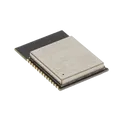
802.15.4, Bluetooth, WiFi Bluetooth v5.0, Zigbee Transceiver Module 2.4GHz PCB Trace Surface Mount The ESP32-C6-WROOM-1-N8 integrates a 32-bit RISC-V single-core processor running up to 160 MHz, along with 8 MB of embedded SPI flash memory. It supports multiple wireless communication protocols, including: Wi-Fi 6 (802.11ax) in the 2.4 GHz band for improved efficiency and lower latency Bluetooth Low Energy (BLE 5) for short-range communication IEEE 802.15.4 for protocols such as Thread and Zigbee The module features a built-in PCB antenna, RF circuitry, crystal oscillator, and passive components, making it a complete solution that simplifies hardware design. It provides a wide range of GPIO pins and peripheral interfaces such as UART, SPI, I2C, PWM, ADC, and more, enabling flexible integration with sensors and external devices. Designed for low power consumption, it includes multiple power-saving modes, making it suitable for battery-powered applications. Typical Applications Smart home and IoT devices Wireless sensors and control systems Industrial automation Smart lighting and energy management Matter-compatible devices (via Thread support)
187 Uses0 Stars