Oscillators
An oscillator is an electronic circuit that generates a periodic, oscillating signal, often a sine wave or a square wave. Oscillators are used in a wide range of applications, including clocks, radios, and sound synthesis. Flux.ai has the world's largest community-driven public library of oscillators, with footprints, symbols, datasheets, and simulation models. This comprehensive resource allows engineers and designers to easily find the oscillator they need for their specific application and use it with confidence. Whether you are working on a simple clock circuit or a complex radio transmitter, Flux.ai's oscillator library has you covered. So, if you are in need of an oscillator for your next project, be sure to check out Flux.ai's extensive collection.
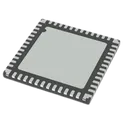
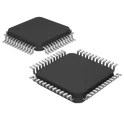
DSPIC33CK128MP205-I/M4
dsPIC dsPIC™ 33CK, Functional Safety (FuSa) Microcontroller IC 16-Bit 100MHz 128KB (128K x 8) FLASH 48-UQFN (6x6) 28/36/48/64/80-Pin Digital Signal Controllers with High-Resolution PWM and CAN Flexible Data (CAN FD) perating Conditions • 3.0V to 3.6V, -40°C to +125°C, DC to 100 MIPS • 3.0V to 3.6V, -40°C to +150°C, DC to 70 MIPS Core: 16-Bit dsPIC33CK CPU • 32-256 Kbytes of Program Flash with ECC and 8-24K RAM • Fast 6-Cycle Divide • LiveUpdate • Code Efficient (C and Assembly) Architecture • 40-Bit Wide Accumulators • Single-Cycle (MAC/MPY) with Dual Data Fetch • Single-Cycle, Mixed-Sign MUL Plus Hardware Divide • 32-Bit Multiply Support • Four Sets of Interrupt Context Saving Registers which Include Accumulator and STATUS for Fast Interrupt Handling • Zero Overhead Looping • RAM Memory Built-In Self-Test (MBIST) Clock Management • Internal Oscillator • Programmable PLLs and Oscillator Clock Sources • Reference Clock Output • Fail-Safe Clock Monitor (FSCM) • Fast Wake-up and Start-up • Backup Internal Oscillator Power Management • Low-Power Management Modes (Sleep, Idle, Doze) • Integrated Power-on Reset and Brown-out Reset High-Speed PWM • Eight PWM Pairs • Up to 250 ps PWM Resolution • Dead Time for Rising and Falling Edges • Dead-Time Compensation • Clock Chopping for High-Frequency Operation • PWM Support for: - DC/DC, AC/DC, inverters, PFC, lighting - BLDC, PMSM, ACIM, SRM motors • Fault and Current Limit Inputs • Flexible Trigger Configuration for ADC Triggering Timers/Output Compare/Input Capture • One General Purpose Timer • Peripheral Trigger Generator (PTG): - Up to 15 trigger sources to other peripheral modules - CPU independent state machine-based instruction sequencer • Nine MCCP/SCCP modules which Include Timer, Capture/Compare and PWM: - One MCCP - Eight SCCPs - 16 or 32-bit time base - 16 or 32-bit capture - 4-deep capture buffer • Fully Asynchronous Operation, Available in Sleep Modes
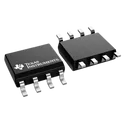
6 Uses0 StarsTLC555IDR
555 Type, Timer/Oscillator (Single) IC 2.1MHz 8-SOIC The TLC555IDR is a low-power CMOS timer device designed as a functional replacement for the standard bipolar 555 timer while providing significantly reduced supply current and improved operating efficiency. The device supports both astable and monostable operating modes and is commonly used for timing generation, pulse shaping, oscillation, PWM generation, delay circuits, and frequency generation applications. The CMOS architecture enables low power consumption, rail-to-rail output capability, and stable timing performance over a wide operating voltage range. The device is suitable for battery-powered systems, portable electronics, industrial controls, instrumentation, consumer products, and embedded electronic designs. The TLC555IDR is supplied in a compact SOIC surface-mount package intended for automated PCB assembly and space-constrained applications. Electrical Characteristics CMOS low-power timer architecture Functional equivalent to standard 555 timer devices Wide operating supply voltage range Low quiescent supply current High input impedance Rail-to-rail output swing capability Stable threshold and trigger levels Compatible with TTL and CMOS logic levels Capable of astable and monostable operation Adjustable duty cycle and frequency operation High output drive capability for direct interfacing Low noise and improved switching performance compared to bipolar 555 timers Functional Features Precision timing generation Oscillator and clock generation Pulse-width modulation support One-shot pulse generation Delay timer implementation Missing pulse detection Frequency divider implementation Sequential timing control LED flashing and tone generation PWM motor and power control applications Package Information Surface-mount SOIC package Standard tape-and-reel packaging format Compact footprint for automated assembly RoHS compliant device construction Environmental and Operating Conditions Industrial operating temperature range ESD protection handling required Suitable for commercial and industrial embedded systems Designed for low-power electronic applications Typical Applications Timer circuits Pulse generators Oscillators PWM controllers LED flashers Alarm and tone generators Frequency generators Power management timing Embedded control systems Portable battery-powered electronics #commonpartslibrary #integratedcircuit #timer #oscillator
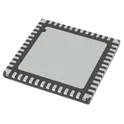
137 Uses0 StarsdsPIC33CK256MP205-I/M4
dsPIC dsPIC™ 33CK, Functional Safety (FuSa) Microcontroller IC 16-Bit 100MHz 256KB (256K x 8) FLASH 48-UQFN (6x6) 28/36/48/64/80-Pin Digital Signal Controllers with High-Resolution PWM and CAN Flexible Data (CAN FD) Operating Conditions • 3.0V to 3.6V, -40°C to +125°C, DC to 100 MIPS • 3.0V to 3.6V, -40°C to +150°C, DC to 70 MIPS Core: 16-Bit dsPIC33CK CPU • 32-256 Kbytes of Program Flash with ECC and 8-24K RAM • Fast 6-Cycle Divide • LiveUpdate • Code Efficient (C and Assembly) Architecture • 40-Bit Wide Accumulators • Single-Cycle (MAC/MPY) with Dual Data Fetch • Single-Cycle, Mixed-Sign MUL Plus Hardware Divide • 32-Bit Multiply Support • Four Sets of Interrupt Context Saving Registers which Include Accumulator and STATUS for Fast Interrupt Handling • Zero Overhead Looping • RAM Memory Built-In Self-Test (MBIST) Clock Management • Internal Oscillator • Programmable PLLs and Oscillator Clock Sources • Reference Clock Output • Fail-Safe Clock Monitor (FSCM) • Fast Wake-up and Start-up • Backup Internal Oscillator Power Management • Low-Power Management Modes (Sleep, Idle, Doze) • Integrated Power-on Reset and Brown-out Reset High-Speed PWM • Eight PWM Pairs • Up to 250 ps PWM Resolution • Dead Time for Rising and Falling Edges • Dead-Time Compensation • Clock Chopping for High-Frequency Operation • PWM Support for: - DC/DC, AC/DC, inverters, PFC, lighting - BLDC, PMSM, ACIM, SRM motors • Fault and Current Limit Inputs • Flexible Trigger Configuration for ADC Triggering Timers/Output Compare/Input Capture • One General Purpose Timer • Peripheral Trigger Generator (PTG): - Up to 15 trigger sources to other peripheral modules - CPU independent state machine-based instruction sequencer • Nine MCCP/SCCP modules which Include Timer, Capture/Compare and PWM: - One MCCP - Eight SCCPs - 16 or 32-bit time base - 16 or 32-bit capture - 4-deep capture buffer • Fully Asynchronous Operation, Available in Sleep Modes #CommonPartsLibrary #IntegratedCircuit #Microcontroller #DSPIC33CK256MP
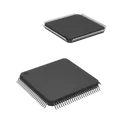
10 Uses0 StarsSTM32F407VGT6
ARM Microcontrollers - MCU ARM M4 1024 FLASH 168 Mhz 192kB SRAM 100-LQFP (14x14) Arm® Cortex®-M4 32b MCU+FPU, 210DMIPS, up to 1MB Flash/192+4KB RAM, USB OTG HS/FS, Ethernet, 17 TIMs, 3 ADCs, 15 comm. interfaces & camera • Core: Arm® 32-bit Cortex®-M4 CPU with FPU, Adaptive real-time accelerator (ART Accelerator) allowing 0-wait state execution from Flash memory, frequency up to 168 MHz, memory protection unit, 210 DMIPS/ 1.25 DMIPS/MHz (Dhrystone 2.1), and DSP instructions • Memories – Up to 1 Mbyte of Flash memory – Up to 192+4 Kbytes of SRAM including 64- Kbyte of CCM (core coupled memory) data RAM – 512 bytes of OTP memory – Flexible static memory controller supporting Compact Flash, SRAM, PSRAM, NOR and NAND memories • LCD parallel interface, 8080/6800 modes • Clock, reset and supply management – 1.8 V to 3.6 V application supply and I/Os – POR, PDR, PVD and BOR – 4-to-26 MHz crystal oscillator – Internal 16 MHz factory-trimmed RC (1% accuracy) – 32 kHz oscillator for RTC with calibration – Internal 32 kHz RC with calibration • Low-power operation – Sleep, Stop and Standby modes –VBAT supply for RTC, 20×32 bit backup registers + optional 4 KB backup SRAM • 3×12-bit, 2.4 MSPS A/D converters: up to 24 channels and 7.2 MSPS in triple interleaved mode • 2×12-bit D/A converters • General-purpose DMA: 16-stream DMA controller with FIFOs and burst support • Up to 17 timers: up to twelve 16-bit and two 32- bit timers up to 168 MHz, each with up to 4 IC/OC/PWM or pulse counter and quadrature (incremental) encoder input • Debug mode – Serial wire debug (SWD) & JTAG interfaces – Cortex-M4 Embedded Trace Macrocell™ • Up to 140 I/O ports with interrupt capability – Up to 136 fast I/Os up to 84 MHz – Up to 138 5 V-tolerant I/Os • Up to 15 communication interfaces – Up to 3 × I2C interfaces (SMBus/PMBus) – Up to 4 USARTs/2 UARTs (10.5 Mbit/s, ISO 7816 interface, LIN, IrDA, modem control) – Up to 3 SPIs (42 Mbits/s), 2 with muxed full-duplex I2S to achieve audio class accuracy via internal audio PLL or external clock – 2 × CAN interfaces (2.0B Active) – SDIO interface • Advanced connectivity – USB 2.0 full-speed device/host/OTG controller with on-chip PHY – USB 2.0 high-speed/full-speed device/host/OTG controller with dedicated DMA, on-chip full-speed PHY and ULPI – 10/100 Ethernet MAC with dedicated DMA: supports IEEE 1588v2 hardware, MII/RMII #CommonPartsLibrary #IntegratedCircuit #Microcontroller #STM32F407
62 Uses0 StarsLM393N
Comparator Standard (General Purpose) Open-Collector, Rail-to-Rail 8-PDIP The LM393N is a dual independent voltage comparator designed for operation from a single power supply over a wide range of voltages. It can also operate from split power supplies, allowing flexible integration into analog and mixed-signal systems. Each comparator features high gain and low input offset voltage, enabling precise comparison between two input signals. The device is optimized for low power consumption and supports open-collector outputs, making it suitable for interfacing with a variety of logic families and external circuits. Its robust design allows reliable performance across a broad temperature range, making it appropriate for industrial, automotive, and consumer applications. Functional Overview The device contains two separate comparators sharing a common power supply. Each comparator compares the voltage at its inverting and non-inverting inputs and drives the output transistor accordingly. The open-collector output stage allows wired-OR configurations and easy level shifting using an external pull-up resistor. When the non-inverting input voltage exceeds the inverting input voltage, the output transistor turns off, allowing the output to be pulled high externally. When the inverting input is higher, the transistor conducts and pulls the output low. Electrical Characteristics The LM393N operates over a wide supply voltage range and exhibits low input bias current and low input offset voltage, contributing to stable and accurate performance. The input common-mode voltage range includes ground, enabling ground-referenced sensing. The output stage is capable of sinking current sufficient to drive loads such as LEDs, relays (with appropriate buffering), or logic inputs. The device is designed for low supply current, supporting energy-efficient designs. Input and Output Behavior Inputs are high impedance and suitable for direct connection to sensors, reference voltages, or signal conditioning networks. The output requires an external pull-up resistor to define the high logic level. This configuration allows flexibility in selecting output voltage levels independent of the supply voltage, within device limits. The open-collector structure also supports multiple outputs connected together for logical operations. Thermal and Environmental Conditions The device is specified for operation across a wide temperature range, ensuring stable functionality under varying environmental conditions. Proper thermal management and adherence to recommended operating conditions ensure long-term reliability. Packaging and Pin Configuration The LM393N is typically provided in a dual in-line package suitable for through-hole mounting. The pin configuration supports two independent comparator channels, each with inverting input, non-inverting input, and output, along with shared power supply and ground connections. Applications The LM393N is suitable for voltage level detection, threshold sensing, zero-crossing detection, oscillator circuits, pulse generation, and analog-to-digital interfacing. It is commonly used in power management systems, battery monitoring, signal conditioning, and embedded control systems. Design Considerations External components such as pull-up resistors, input filtering networks, and hysteresis feedback may be required depending on the application. Careful layout and noise considerations improve performance in high-sensitivity circuits. The open-collector output requires proper configuration to ensure correct logic levels and switching behavior. #commonpartslibrary #integratedcircuit #comparator
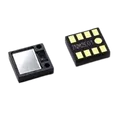
29 Uses0 StarsPAT9125EL-TKIT
The PAT9125EL-TKIT from PixArt Imaging Inc. is a low-power optical tracking miniature chip designed for precise motion detection using laser-based optical navigation technology. It integrates both the optical sensor and VCSEL laser light source into a single compact package, enabling accurate tracking even on smooth or glossy surfaces. This device captures sequential surface images and processes them internally to determine movement direction, speed, and displacement (X/Y data), which can be accessed by a host controller via digital interfaces. It is particularly suited for space-constrained, battery-powered, and enclosed systems, eliminating the need for mechanical components like code wheels or special surface markings. Key Features Integrated optical sensor + VCSEL laser (850 nm) in a single package No external lens required, simplifying design Wide depth of field (DOF): 1–30 mm, even on reflective surfaces Programmable resolution up to ~1275 CPI Supports I²C (TKIT) interface (SPI variant available as TKMT) Motion detection interrupt output Built-in oscillator (no external clock needed) Low power consumption: Run: ~0.7 mA Sleep: down to 10 µA Power-down: ~5 µA Pre-calibrated laser (no calibration required) IEC/EN 60825-1 Class 1 eye-safe laser compliant Key Specifications Supply Voltage: VDD: 1.7–3.6 V VLD (laser): 2.7–3.6 V Max Tracking Speed: up to ~30 inches/sec Package: 8-pin LGA (3.5 × 3.2 × 1.0 mm) Interface: I²C (for TKIT variant)
5 Uses0 StarsSTM32F103C8T6
ARM® Cortex® M3 STM32F1 Microcontroller IC 32-Bit Single-Core 72MHz 64KB (64K x 8) FLASH Medium-density performance line Arm®-based 32-bit MCU with 64 or 128 KB Flash, USB, CAN, 7 timers, 2 ADCs, 9 com. interfaces Arm® 32-bit Cortex®-M3 CPU core – 72 MHz maximum frequency, 1.25 DMIPS/MHz (Dhrystone 2.1) performance at 0 wait state memory access – Single-cycle multiplication and hardware division • Memories – 64 or 128 Kbytes of Flash memory – 20 Kbytes of SRAM • Clock, reset and supply management – 2.0 to 3.6 V application supply and I/Os – POR, PDR, and programmable voltage detector (PVD) – 4 to 16 MHz crystal oscillator – Internal 8 MHz factory-trimmed RC – Internal 40 kHz RC – PLL for CPU clock – 32 kHz oscillator for RTC with calibration • Low-power – Sleep, Stop and Standby modes – VBAT supply for RTC and backup registers • 2x 12-bit, 1 µs A/D converters (up to 16 channels) – Conversion range: 0 to 3.6 V – Dual-sample and hold capability – Temperature sensor • DMA – 7-channel DMA controller – Peripherals supported: timers, ADC, SPIs, I 2Cs and USARTs • Up to 80 fast I/O ports – 26/37/51/80 I/Os, all mappable on 16 external interrupt vectors and almost all 5 V-tolerant Debug mode: – Serial wire debug (SWD) and JTAG interfaces • Seven timers – Three 16-bit timers, each with up to 4 IC/OC/PWM or pulse counter and quadrature (incremental) encoder input – 16-bit, motor control PWM timer with dead-time generation and emergency stop – Two watchdog timers (independent and window) – SysTick timer 24-bit downcounter • Up to nine communication interfaces – Up to two I2C interfaces (SMBus/PMBus®) – Up to three USARTs (ISO 7816 interface, LIN, IrDA capability, modem control) – Up to two SPIs (18 Mbit/s) – CAN interface (2.0B Active) – USB 2.0 full-speed interface • CRC calculation unit, 96-bit unique ID • Packages are ECOPACK #commonpartslibrary #integratedcircuit #microcontroller #stm32f1
36 Uses0 StarsFL2500283Z
25 MHz ±30ppm Crystal 20pF 50 Ohms 4-SMD, No Lead The FL2500283Z is a 25 MHz surface-mount quartz crystal manufactured by Diodes Incorporated, part of the FL series (SaRonix-eCera™). It is designed for use as a stable clock reference in digital circuits such as microcontrollers, communication modules, and embedded systems. This crystal uses an AT-cut resonator inside a compact 3.2 mm × 2.5 mm (3225) ceramic package, making it suitable for high-density PCB designs and modern electronics. Key Features Standard Frequency 25 MHz fundamental mode crystal Compact SMD Package 3.2 × 2.5 mm (3225), 4-pad configuration Height ~0.68–0.75 mm AT-Cut Quartz Technology Provides good frequency stability and low drift Frequency Stability & Tolerance Typical: ±10 to ±30 ppm Load Capacitance Typically 20 pF Low ESR Around 50–60 Ω, suitable for MCU oscillator circuits Wide Operating Temperature Common range: -20°C to +70°C (some variants up to -40°C to +125°C) Surface-Mount Compatibility Ideal for automated assembly and reflow soldering RoHS / Lead-Free Environmentally compliant design Typical Applications Microcontroller clock (STM32, ESP32, AVR, etc.) Communication modules (Wi-Fi, Ethernet, RF) Embedded systems Consumer electronics Industrial control boards #Crystal #Oscillator #Resonator #SaRonix-eCera™ FL
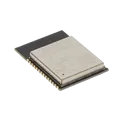
121 Uses0 StarsESP32-C6-WROOM-1-N8
802.15.4, Bluetooth, WiFi Bluetooth v5.0, Zigbee Transceiver Module 2.4GHz PCB Trace Surface Mount The ESP32-C6-WROOM-1-N8 integrates a 32-bit RISC-V single-core processor running up to 160 MHz, along with 8 MB of embedded SPI flash memory. It supports multiple wireless communication protocols, including: Wi-Fi 6 (802.11ax) in the 2.4 GHz band for improved efficiency and lower latency Bluetooth Low Energy (BLE 5) for short-range communication IEEE 802.15.4 for protocols such as Thread and Zigbee The module features a built-in PCB antenna, RF circuitry, crystal oscillator, and passive components, making it a complete solution that simplifies hardware design. It provides a wide range of GPIO pins and peripheral interfaces such as UART, SPI, I2C, PWM, ADC, and more, enabling flexible integration with sensors and external devices. Designed for low power consumption, it includes multiple power-saving modes, making it suitable for battery-powered applications. Typical Applications Smart home and IoT devices Wireless sensors and control systems Industrial automation Smart lighting and energy management Matter-compatible devices (via Thread support)
214 Uses0 StarsCA3046
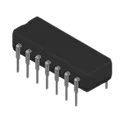
RF Transistor 5 NPN 15V 50mA 550MHz 300mW Through Hole 14-PDIP The CA3046 contains five matched NPN bipolar junction transistors (BJTs) integrated on a single silicon chip. These transistors share a common substrate but are electrically isolated from each other, allowing flexible circuit configurations. It is commonly used in analog circuits where closely matched transistor characteristics are required, such as differential amplifiers and current mirrors. Key Features Type: NPN transistor array IC Number of Transistors: 5 matched transistors Integrated Structure: Monolithic silicon chip Isolation: Each transistor is individually accessible Matching: Good thermal and electrical matching between transistors Package: Typically 14-pin DIP or SOIC (varies by manufacturer) Electrical Characteristics (typical) Collector-emitter voltage (Vce): up to ~15 V (varies by variant) Collector current: a few milliamps per transistor (low-power signal applications) Frequency response: suitable for low to medium-frequency analog circuits Operating temperature: industrial range (depends on manufacturer spec) Typical Applications Differential amplifiers Current mirrors Temperature sensing circuits Signal processing circuits Oscillators and timing circuits General-purpose analog transistor building blocks #CommonPartsLibrary #Transistor # BJT #RF-transistor #Bipolar
2 Uses0 Stars