Microcontrollers
A microcontroller is a small, low-cost computer-on-a-chip that can be used to control electronic devices and systems. It consists of a central processing unit (CPU), memory, input/output (I/O) ports, and other peripherals integrated onto a single chip. Microcontrollers are commonly used in a wide range of applications, including automotive systems, home appliances, industrial automation, and consumer electronics. One of the key benefits of microcontrollers is their ability to interact with their environment through sensors and actuators, making them well-suited for use in embedded systems. These systems are often found in devices that require real-time control or data processing, such as medical equipment, aircraft, and factory automation systems. Flux.ai is home to the world's largest community-driven public library of microcontrollers, with footprints, symbols, datasheets, and simulation models for a wide range of devices. Whether you're a professional engineer looking for a specific microcontroller for your next project, or a hobbyist exploring the possibilities of microcontroller-based systems, Flux.ai has the resources you need to get started.
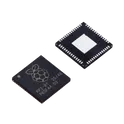
RP2040
133MHz LQFN-56(7x7) Microcontrollers (MCU/MPU/SOC) ROHS RP2040 The RP2040 is a high-performance, low-cost 32-bit microcontroller developed by Raspberry Pi Ltd.. It features dual ARM Cortex-M0+ processor cores, flexible digital interfaces, and a unique Programmable I/O (PIO) subsystem that enables custom hardware protocols and timing-critical applications. The device is widely used in embedded systems, IoT devices, robotics, industrial control, consumer electronics, and educational projects. Key Features Dual ARM Cortex-M0+ CPU cores operating up to 133 MHz (up to 200 MHz under specific conditions) 264 KB on-chip SRAM organized in six independent memory banks External QSPI Flash interface with Execute-In-Place (XIP) support and up to 16 MB Flash memory capability 30 multifunction GPIO pins with extensive peripheral multiplexing 2 × UART interfaces 2 × SPI controllers 2 × I²C controllers 16 PWM channels for motor control and signal generation USB 1.1 Host and Device support with integrated PHY 12-bit ADC with four external analog inputs and internal temperature sensor, up to 500 ksps sampling rate 12-channel DMA controller for efficient data transfers Programmable I/O (PIO) subsystem with 8 state machines for implementing custom communication interfaces and precise timing applications Integrated PLLs and programmable LDO regulator for clock and power management Operating voltage range: 1.8 V to 3.3 V Available in a compact 7 mm × 7 mm QFN-56 package Typical Applications IoT and connected devices Industrial automation Robotics and motor control Human-machine interfaces (HMI) Consumer electronics USB peripherals Sensor data acquisition systems Educational and maker projects Custom communication protocol implementations using PIO #CommonPartsLibrary #IntegratedCircuit #Microcontroller
125 Uses0 StarsCD74HC4067M
The CD74HC4067M is a high-speed CMOS analog multiplexer and demultiplexer designed to route one of multiple analog or digital signals to a common input/output line. Built using advanced high-speed CMOS technology, this device provides low ON-state resistance, wide signal bandwidth, and low power consumption, making it suitable for signal routing, data acquisition systems, sensor expansion, communication interfaces, industrial control systems, and embedded electronics. The integrated channel selection logic enables efficient switching between multiple signal paths while maintaining signal integrity and minimizing distortion. Features High-speed CMOS analog multiplexer and demultiplexer architecture Multiple single-ended channels connected to a common input/output Low ON-state resistance for reduced signal loss Wide analog signal handling capability Bidirectional signal switching support Compatible with both analog and digital signals Low power consumption during operation Break-before-make switching characteristic High noise immunity Wide operating supply voltage range Direct interface compatibility with microcontrollers and digital logic devices Low crosstalk and low leakage current performance Surface-mount package optimized for automated assembly Applications Sensor multiplexing systems Data acquisition equipment Industrial automation controllers Embedded electronics Test and measurement instruments Communication systems Audio signal routing Battery monitoring systems Medical instrumentation Consumer electronic products Microcontroller input expansion Analog signal selection networks Electrical Characteristics CMOS logic implementation Analog and digital signal switching capability Low propagation delay Low channel capacitance Low leakage current High switching speed Wide bandwidth operation ESD protection features High input impedance Low standby power consumption Mechanical Characteristics Surface-mount integrated circuit package Compact footprint for high-density PCB layouts RoHS-compliant construction Suitable for automated pick-and-place assembly Standard industry package dimensions Design Considerations Use proper decoupling capacitors near supply pins Keep analog signal traces short to minimize noise pickup Ensure signals remain within specified supply voltage limits Consider ON-resistance effects in precision analog applications Implement appropriate PCB grounding techniques for optimal performance Avoid exceeding maximum switching current ratings #commonpartslibrary #integratedcircuit #analog #digital #multiplexer #demultiplexer #signalrouting #analogswitch #dataacquisition #embeddedsystems #industrialelectronics #texasinstruments
108 Uses0 StarsESP32-C3FH4
The ESP32-C3FH4 is a highly integrated wireless microcontroller designed for Internet of Things, smart devices, industrial automation, consumer electronics, and embedded connectivity applications. It combines a low-power RISC-V processor with integrated Wi-Fi and Bluetooth Low Energy connectivity, providing a cost-effective and secure platform for wireless communication and edge computing. The device incorporates embedded flash memory, advanced security features, low-power operating modes, and a rich set of peripheral interfaces, making it suitable for battery-powered and always-connected systems. Its compact design and comprehensive software ecosystem enable rapid development of connected products while maintaining high reliability and energy efficiency. The ESP32-C3FH4 is widely used in smart sensors, home automation devices, wearable electronics, industrial monitoring systems, wireless control modules, and cloud-connected embedded products. Features Integrated RISC-V microcontroller core Built-in Wi-Fi connectivity Integrated Bluetooth Low Energy support Embedded flash memory Low-power operation for battery-powered applications Hardware cryptographic acceleration Secure boot capability Flash encryption support Multiple GPIO interfaces Integrated UART, SPI, I²C, I²S, PWM, and ADC peripherals Real-time processing capability Wireless networking and cloud connectivity support OTA firmware update support Compact surface-mount package Industrial-grade reliability Electrical Characteristics Wireless microcontroller architecture Integrated RF subsystem Low-power operating modes High-performance embedded processing Secure communication support Multi-protocol wireless connectivity Flexible peripheral expansion capability Optimized power consumption for IoT devices Applications Internet of Things devices Smart home automation Wireless sensor networks Industrial monitoring systems Asset tracking devices Wearable electronics Smart appliances Remote control systems Data acquisition platforms Edge computing applications Connected consumer products Embedded wireless gateways Package Information Surface-mount package Compact footprint for embedded applications Suitable for automated assembly processes Optimized thermal and electrical performance PCB-friendly package design #commonpartslibrary #integratedcircuit #microcontroller #wirelessconnectivity #wifi #bluetoothlowenergy #iot #embeddedsystems #espressif #smartdevices #industrialautomation #edgecomputing #wirelessmodule #internetofthings #electronicsdesign #riscv #embeddedelectronics #lowpowerdesign
53 Uses0 StarsTPS54531DDA
The TPS54531DDA is a high-efficiency step-down switching regulator designed for converting higher input voltages into regulated lower output voltages. It integrates a power MOSFET, control circuitry, and protection features into a compact package, enabling simplified power supply design for a wide range of industrial, consumer, communication, and embedded applications. The device utilizes current-mode control architecture to provide fast transient response, stable operation, and straightforward loop compensation. It supports a wide input voltage range and delivers efficient power conversion while minimizing external component count. Built-in protection mechanisms enhance system reliability by safeguarding against fault conditions such as overcurrent, undervoltage, and thermal overload. The TPS54531DDA is commonly used in distributed power systems, industrial controllers, networking equipment, telecommunications hardware, battery-powered devices, and embedded computing platforms requiring efficient voltage regulation. Features Integrated high-side power MOSFET High-efficiency buck regulator architecture Wide input voltage operating range Current-mode control operation Adjustable output voltage capability Fast transient response performance Internal soft-start functionality Cycle-by-cycle current limiting protection Thermal shutdown protection Undervoltage lockout protection Frequency compensation support Low standby current operation Compact surface-mount package Suitable for industrial temperature environments Electrical Characteristics Step-down DC/DC conversion topology Fixed switching frequency operation Adjustable output regulation High conversion efficiency across load conditions Stable operation with ceramic output capacitors Integrated power switch architecture Low output voltage ripple performance High load regulation accuracy Applications Industrial automation systems Embedded processors and microcontrollers Communication equipment Networking hardware Distributed power architectures Point-of-load regulators Consumer electronic products Measurement and instrumentation equipment Battery-powered systems Digital control platforms Package Information Package Type: SO PowerPAD package Surface-mount assembly compatible Thermally enhanced package construction Optimized for automated PCB manufacturing Compact footprint for space-constrained designs #commonpartslibrary #integratedcircuit #powermanagement #powersupply #buckconverter #dcdcconverter #switchingregulator #voltageregulator #embeddedsystems #industrialelectronics #powerelectronics #texasinstruments #energyefficiency #electronicsdesign #powersupplycontroller
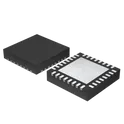
34 Uses0 StarsCP2102N-A02-GQFN24
USB-to-UART Bridge CP2102N-A02-GQFN24 is a highly integrated USB-to-UART bridge controller from Silicon Labs. It provides a simple and cost-effective way to add USB connectivity to embedded systems by converting USB 2.0 Full-Speed communication into a standard UART interface. The device integrates the USB transceiver, oscillator, voltage regulator, and UART controller, minimizing external components and eliminating the need for USB firmware development. It is commonly used in microcontroller programming interfaces, industrial equipment, POS terminals, data loggers, and USB-to-serial adapters. Key Features USB 2.0 Full-Speed compliant (12 Mbps) interface. USB-to-UART bridge with data rates up to 3 Mbaud. Integrated USB transceiver; no external USB resistors required. Integrated oscillator; no external crystal required. On-chip 3.3 V voltage regulator. USB Battery Charger Detection (BC 1.2) support. Remote wakeup capability from USB suspend state. Low operating current of approximately 9.5 mA. Hardware and software flow control support. Internal configurable ROM for Vendor ID, Product ID, serial number, and USB descriptors. Royalty-free Virtual COM Port (VCP) drivers available for major operating systems. Operating temperature range: −40°C to +85°C. Compact 24-pin QFN (4 mm × 4 mm) package. Typical Applications USB-to-Serial adapters Microcontroller programming and debugging interfaces Industrial automation equipment Point-of-sale (POS) terminals Medical instruments Data acquisition and logging systems Embedded systems requiring USB connectivity #commonpartslibrary #integratedcircuit
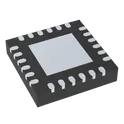
217 Uses0 StarsCP2102N-A02-GQFN28R
USB-to-UART Bridge CP2102N CP2102N-A02-GQFN28R is a highly integrated USB-to-UART bridge controller from Silicon Labs that provides a simple and reliable interface between a USB host and an embedded system using a UART serial port. It eliminates the need for complex USB firmware development by handling all USB protocol functions internally and presenting a standard UART interface to the target device. The device is commonly used in microcontroller programming, debugging, industrial equipment, IoT devices, and USB-to-serial adapters. logging equipment Consumer and portable electronics Function: USB-to-UART Bridge Controller
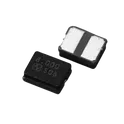
96 Uses0 StarsNX3225GD 8.000MHZ STD-CRA-3
The NX3225GD 8.000MHz STD-CRA-3 is a surface-mount quartz crystal resonator designed to provide a stable and accurate clock reference for electronic circuits. It is housed in a compact ceramic package suitable for space-constrained applications and is optimized for low power consumption and reliable frequency generation. This crystal is commonly used in microcontrollers, wireless communication modules, industrial control systems, consumer electronics, IoT devices, and embedded systems requiring precise timing and frequency control. Features Fundamental mode quartz crystal resonator Nominal frequency of 8.000 MHz Compact surface-mount ceramic package High frequency stability and accuracy Low equivalent series resistance Suitable for low-power oscillator circuits Excellent aging characteristics RoHS-compliant construction Designed for automated SMT assembly processes Reliable operation across industrial temperature environments Electrical Characteristics Crystal type: Quartz Crystal Resonator Frequency: 8.000 MHz Oscillation mode: Fundamental Load capacitance: Standard load capacitance configuration Frequency tolerance: Standard precision grade Frequency stability: Industrial-grade stability performance Equivalent series resistance optimized for MCU and RF oscillator circuits Low drive level operation High insulation resistance Mechanical Characteristics Surface-mount package Ceramic hermetic enclosure Compact footprint suitable for high-density PCB layouts Compatible with standard reflow soldering processes Designed for automated pick-and-place assembly Applications Microcontroller clock generation Wireless communication devices Bluetooth and RF modules IoT and smart devices Industrial automation equipment Embedded control systems Consumer electronics Timing and synchronization circuits Sensor interface modules Portable battery-powered products Compliance RoHS compliant Lead-free package Environmentally friendly manufacturing standards Suitable for commercial and industrial electronic applications #commonpartslibrary #crystal #quartzcrystal #frequencycontrol #timingdevice #clocksource #oscillator #smtcomponent #embeddedsystems #wirelesscommunication #industrialelectronics #consumerelectronics #iotdevices #passivecomponents #electroniccomponents
31 Uses0 Stars