Capacitors
A capacitor is a passive electronic component that stores electrical charge and is commonly used to store energy in a circuit. Capacitors are used in a wide range of applications including power supply filtering, signal coupling, and decoupling, noise suppression, and voltage dividing. One of the main use cases of capacitors is to smooth out fluctuations in a direct current (DC) power supply by acting as a temporary reservoir of electrical charge. Capacitors can also be used to block the flow of direct current while allowing alternating current to pass, making them useful for signal coupling and decoupling in audio and radio frequency circuits. Flux.ai is the world's largest community-driven public library of capacitors, offering footprints, symbols, datasheets, and simulation models for a wide range of capacitor types. Whether you're an engineer looking for detailed technical information or a maker in need of resources for your latest project, Flux.ai has you covered.
NCP176BMX330TCG
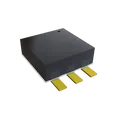
The Onsemi NCP176 CMOS Low Dropout (LDO) Regulator is designed for superior transient response and low voltage operation, providing a maximum output current of 500 mA. It operates with an input voltage range from 1.4 V to 5.5 V and offers an output voltage range from 0.7 V to 3.6 V in 0.1 V steps. Characterized by a typical quiescent current of 60 µA and a low dropout voltage of 130 mV at 500 mA with a 2.5 V output, the NCP176 ensures high output voltage accuracy of ±0.8% for outputs above 1.8 V. The regulator is stable with small 1 µF ceramic capacitors and includes features such as over-current protection, built-in soft start to suppress inrush current, thermal shutdown protection at 165℃, and an optional output discharge function available in the NCP176A variant. Packaged in a compact XDFN6 1.2 mm x 1.2 mm x 0.4 mm, this LDO regulator is ideal for battery-powered equipment, portable communication devices, and cameras.
6.2k Uses1 Stars