Voltage Regulators
A voltage regulator is an electronic device that maintains a constant output voltage level, regardless of changes in the input voltage or load conditions. These devices are commonly used to provide a stable power supply to electronic circuits, as well as to protect them from voltage spikes and surges. There are several types of voltage regulators, including linear, switching, and pulse width modulation (PWM) regulators, each with its own set of characteristics and applications. Linear regulators, for example, are simple and efficient, but have a relatively low switching speed and can only provide a limited output current. Switching regulators, on the other hand, have higher switching speeds and can provide a higher output current, but are more complex and require additional components. In addition to their use in power supplies and voltage protection, voltage regulators are also used in a wide range of other applications, including motor control, battery charging, and instrumentation. Flux.ai has the world's largest community-driven public library of voltage regulators, with footprints, symbols, datasheets, and simulation models for a wide range of devices. Whether you're a designer, engineer, or hobbyist, you can find the resources you need to get your project up and running quickly and efficiently.
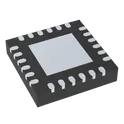
CP2102N-A02-GQFN24
USB-to-UART Bridge CP2102N-A02-GQFN24 is a highly integrated USB-to-UART bridge controller from Silicon Labs. It provides a simple and cost-effective way to add USB connectivity to embedded systems by converting USB 2.0 Full-Speed communication into a standard UART interface. The device integrates the USB transceiver, oscillator, voltage regulator, and UART controller, minimizing external components and eliminating the need for USB firmware development. It is commonly used in microcontroller programming interfaces, industrial equipment, POS terminals, data loggers, and USB-to-serial adapters. Key Features USB 2.0 Full-Speed compliant (12 Mbps) interface. USB-to-UART bridge with data rates up to 3 Mbaud. Integrated USB transceiver; no external USB resistors required. Integrated oscillator; no external crystal required. On-chip 3.3 V voltage regulator. USB Battery Charger Detection (BC 1.2) support. Remote wakeup capability from USB suspend state. Low operating current of approximately 9.5 mA. Hardware and software flow control support. Internal configurable ROM for Vendor ID, Product ID, serial number, and USB descriptors. Royalty-free Virtual COM Port (VCP) drivers available for major operating systems. Operating temperature range: −40°C to +85°C. Compact 24-pin QFN (4 mm × 4 mm) package. Typical Applications USB-to-Serial adapters Microcontroller programming and debugging interfaces Industrial automation equipment Point-of-sale (POS) terminals Medical instruments Data acquisition and logging systems Embedded systems requiring USB connectivity #commonpartslibrary #integratedcircuit
192 Uses0 StarsTPS54336ADRCR
Buck Switching Regulator IC Positive Adjustable 0.8V 1 Output 3A 10-VFDFN Exposed Pad The TPS5433xA family of devices are synchronous converters with an input-voltage range of 4.5 V to 28 V. These devices include This device has an integrated low-side switching FET that eliminates the need for an external diode which reduces component count. Efficiency is maximized through the integrated 128- mΩ and 84-mΩ MOSFETs, low IQ and pulse skipping at light loads. Using the enable pin, the shutdown supply current is reduced to 2 μA. This step-down (buck) converter provides accurate regulation for a variety of loads with a well-regulated voltage reference that is 1.5% over temperature. Cycle-by-cycle current limiting on the high-side MOSFET protects the TPS5433xA family of devices in overload situations and is enhanced by a low-side sourcing current limit which prevents current runaway. A low-side sinking current-limit turns off the low-side MOSFET to prevent excessive reverse current. Hiccup protection is triggered if the overcurrent condition continues for longer than the preset time. Thermal shutdown disables the device when the die temperature exceeds the threshold and enables the device again after the built-in thermal hiccup time. • Synchronous 128-mΩ and 84-mΩ MOSFETs for 3-A Continuous Output Current • TPS54335A: Internal 2-ms Soft-Start, 50-kHz to 1.5-MHz Adjustable Frequency • TPS54336A: Adjustable Soft-Start, Fixed 340-kHz Frequency • Low 2-µA Shutdown, Quiescent Current • 0.8-V Voltage Reference with ±0.8% Accuracy • Current Mode Control • Monotonic Startup into Pre-Biased Outputs • Pulse Skipping for Light-Load Efficiency • Hiccup Mode Overcurrent Protection • Thermal Shutdown (TSD) and Overvoltage Transition Protection • 8-Pin SO PowerPAD™ and 10-Pin VSON Package • Create a Custom Design Using the TPS54335A with the WEBENCH Power Designer #CommonPartsLibrary #IntegratedCircuit #PowerManagement
126 Uses0 StarsTPS63020DSJT
Buck-Boost Switching Regulator IC Positive Adjustable 1.2V 1 Output 3.5A (Switch) 14-VFDFN Exposed Pad The TPS63020DSJT is a high-efficiency synchronous buck-boost DC-to-DC converter manufactured by Texas Instruments. This integrated power management device is designed to provide a stable regulated output voltage from input power sources that may vary above or below the desired output level. The converter automatically transitions between buck and boost operating modes to maintain efficient and continuous voltage regulation across a wide input range. The device integrates low-resistance power MOSFETs, advanced control circuitry, and high-efficiency switching architecture to minimize power loss and optimize battery utilization in portable electronic systems. It is widely used in battery-powered applications, embedded systems, wireless communication devices, portable instrumentation, industrial electronics, and USB-powered hardware requiring compact and reliable voltage regulation. The TPS63020DSJT is optimized for systems powered by single-cell lithium-ion, lithium-polymer, or multi-cell alkaline battery configurations. Its compact package and integrated functionality reduce external component count and simplify PCB layout while delivering high power conversion efficiency and low quiescent current performance. Engineering Specification Device Type Synchronous buck-boost DC-to-DC converter Power Conversion Topology Automatic buck and boost regulation architecture Input Characteristics Supports input voltages above or below regulated output voltage Output Characteristics Stable regulated DC voltage output Switching Technology Integrated synchronous MOSFET switching architecture Efficiency Characteristics High-efficiency power conversion for battery-powered systems Control Features Automatic operating mode transition and load regulation Power Consumption Low quiescent current operation for portable electronics Thermal Characteristics Integrated thermal management and protection features Protection Features Overcurrent protection Thermal shutdown Undervoltage lockout Short-circuit protection Package Type WSON surface-mount package Mounting Style Surface mount technology Applications Portable electronics Battery-powered systems Embedded hardware Wireless communication devices USB-powered electronics Industrial control systems Portable instrumentation IoT devices Consumer electronics Power management systems Manufacturer Texas Instruments #commonpartslibrary #buckboostconverter #dcdcconverter #powermanagement #texasinstruments #powerelectronics #powersupply #embeddedhardware #portableelectronics #batterypowered #surfaceountcomponents #electronicsdesign #voltageregulator #iothardware #industrialelectronics
81 Uses0 Stars