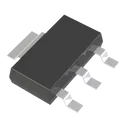
Voltage Regulators
A voltage regulator is an electronic device that maintains a constant output voltage level, regardless of changes in the input voltage or load conditions. These devices are commonly used to provide a stable power supply to electronic circuits, as well as to protect them from voltage spikes and surges. There are several types of voltage regulators, including linear, switching, and pulse width modulation (PWM) regulators, each with its own set of characteristics and applications. Linear regulators, for example, are simple and efficient, but have a relatively low switching speed and can only provide a limited output current. Switching regulators, on the other hand, have higher switching speeds and can provide a higher output current, but are more complex and require additional components. In addition to their use in power supplies and voltage protection, voltage regulators are also used in a wide range of other applications, including motor control, battery charging, and instrumentation. Flux.ai has the world's largest community-driven public library of voltage regulators, with footprints, symbols, datasheets, and simulation models for a wide range of devices. Whether you're a designer, engineer, or hobbyist, you can find the resources you need to get your project up and running quickly and efficiently.
AMS1117-3.3RG
The AMS1117-3.3RG is a fixed-output, low-dropout (LDO) linear voltage regulator that provides a regulated 3.3 V output from a higher input voltage. It is capable of delivering up to 1 A output current and is commonly used in microcontroller, communication, and embedded-system power supplies where a stable 3.3 V rail is required. The device includes built-in protection features such as current limiting and thermal shutdown for improved reliability. Key Features Fixed 3.3 V output voltage Supports up to 1 A output current Low dropout voltage, typically around 1.2 V and up to 1.3 V at 1 A load Input voltage capability up to 12 V (some manufacturer variants specify higher absolute maximum ratings) Good line and load regulation Built-in current limiting protection Built-in thermal shutdown protection Available in SOT-223 surface-mount package Suitable for post-regulation of switching power supplies and general 3.3 V power conversion applications Typical Applications ESP32, STM32, and other microcontroller-based systems Embedded and IoT devices Communication modules LCD monitors and display circuits Battery-powered equipment Post-regulation for DC/DC converters Motherboards and expansion cards #CommonPartsLibrary #IntegratedCircuit #PowerManagement #LDO
137 Uses0 StarsLAN8720A-CP-TR-ABC
Small Footprint RMII 10/100 Ethernet Transceiver with HP Auto-MDIX Support LAN8720A-CP-TR-ABC is a low-power, single-port 10BASE-T/100BASE-TX Ethernet Physical Layer (PHY) transceiver from Microchip Technology. It is designed to connect a microcontroller, processor, or Ethernet MAC to a standard Ethernet network through an RMII (Reduced Media Independent Interface). The device is widely used in embedded networking applications such as industrial controllers, IoT gateways, IP cameras, networked printers, routers, and ESP32-based Ethernet designs. Key Features Single-chip 10/100 Mbps Ethernet PHY Supports both 10BASE-T and 100BASE-TX Ethernet operation. RMII Interface Reduced pin-count interface for easy connection to Ethernet MACs and microcontrollers. IEEE 802.3 / 802.3u Compliant Fully compliant with Fast Ethernet standards. HP Auto-MDIX Support Automatically detects and configures straight-through or crossover Ethernet cables. Auto-Negotiation Automatically selects the best available speed and duplex mode. Flexible I/O Voltage Supports LVCMOS I/O voltages from 1.6 V to 3.6 V, simplifying interfacing with different processors. Integrated 1.2 V Regulator Allows operation from a single 3.3 V supply, reducing external components. Low-Power Architecture Features multiple power-saving modes through Microchip's flexPWR® technology. Built-in Diagnostics and Reliability Features Loopback modes, automatic polarity correction, link-status monitoring, and wake-up detection. Compact Package Available in a 24-pin SQFN/QFN (4 mm × 4 mm) package for space-constrained designs #CommonPartsLibrary #IntegratedCircuit
84 Uses0 Stars