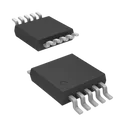
Interface ICs
An interface IC is a type of integrated circuit that is designed to facilitate communication between two devices or systems. These devices are commonly used in electronic systems to enable the transfer of data and control signals between different components or subsystems. Some common use cases for interface ICs include connecting microcontrollers to peripherals such as sensors or displays, linking multiple processors together in a network, and enabling communication between devices using different communication protocols. Flux.ai has the world's largest community-driven public library of interface ICs, with footprints, symbols, datasheets, and simulation models. This library is a valuable resource for engineers and designers who need access to accurate and up-to-date information on these important components. Whether you are working on a new design project or simply looking to learn more about interface ICs, Flux.ai is an excellent resource to help you find the information you need.
MAX31865AAP+T
15Bit 3V~3.6V SPI SSOP-20-208mil Analog to Digital Converters (ADCs) ROHS The MAX31865 is an easy-to-use resistance-to-digital converter optimized for platinum resistance temperature detectors (RTDs). An external resistor sets the sensitivity for the RTD being used and a precision delta-sigma ADC converts the ratio of the RTD resistance to the reference resistance into digital form. The MAX31865’s inputs are protected against overvoltage faults as large as Q45V. Programmable detection of RTD and cable open and short conditions is included. ● Integration Lowers System Cost, Simplifies Design Efforts, and Reduces Design Cycle Time • Simple Conversion of Platinum RTD Resistance to Digital Value • Handles 100Ω to 1kΩ (at 0°C) Platinum RTDs (PT100 to PT1000) • Compatible with 2-, 3-, and 4-Wire Sensor Connections • SPI-Compatible Interface • 20-Pin TQFN and SSOP Packages ● High Accuracy Facilitates Meeting Error Budgets • 15-Bit ADC Resolution; Nominal Temperature Resolution 0.03125NC (Varies Due to RTD Nonlinearity) • Total Accuracy Over All Operating Conditions: 0.5NC (0.05% of Full Scale) max • Fully Differential VREF Inputs • 21ms (max) Conversion Time ● Integrated Fault Detection Increases System Reliability • ±45V Input Protection • Fault Detection (Open RTD Element, RTD Shorted to Out-of-Range Voltage, or Short Across RTD Element) #CommonPartsLibrary #IntegratedCircuit #PowerManagement
156 Uses0 StarsINA228AIDGSR
Power Supply Controller Digital Power Monitor 10-VSSOP The INA228 is an ultra-precise digital power monitor with a 20-bit delta-sigma ADC specifically designed for current-sensing applications. The device can measure a full-scale differential input of ±163.84 mV or ±40.96 mV across a resistive shunt sense element with common-mode voltage support from –0.3 V to +85 V. The INA228 reports current, bus voltage, temperature, power, energy and charge accumulation while employing a precision ±0.5% integrated oscillator, all while performing the needed calculations in the background. The integrated temperature sensor is ±1°C accurate for die temperature measurement and is useful in monitoring the system ambient temperature. The low offset and gain drift design of the INA228 allows the device to be used in precise systems that do not undergo multi-temperature calibration during manufacturing. Further, the very low offset voltage and noise allow for use in mA to kA sensing applications and provide a wide dynamic range without significant power dissipation losses on the sensing shunt element. The low input bias current of the device permits the use of larger currentsense resistors, thus providing accurate current measurements in the micro-amp range. The device allows for selectable ADC conversion times from 50 µs to 4.12 ms as well as sample averaging from 1x to 1024x, which further helps reduce the noise of the measured data. • High-resolution, 20-bit delta-sigma ADC • Current monitoring accuracy: – Offset voltage: ±1 µV (maximum) – Offset drift: ±0.01 µV/°C (maximum) – Gain error: ±0.05% (maximum) – Gain error drift: ±20 ppm/°C (maximum) – Common mode rejection: 154 dB (minimum) • Power monitoring accuracy: – 0.5% full scale, –40°C to +125°C (maximum) • Energy and charge accuracy: – 1.0% full scale (maximum) • Fast alert response: 75 μs • Wide common-mode range: –0.3 V to +85 V • Bus voltage sense input: 0 V to 85 V • Shunt full-scale differential range: ±163.84 mV / ±40.96 mV • Input bias current: 2.5 nA (maximum) • Temperature sensor: ±1°C (maximum at 25°C) • Programmable resistor temperature compensation • Programmable conversion time and averaging • 2.94-MHz high-speed I2C interface with 16 pinselectable addresses • Operates from a 2.7-V to 5.5-V supply: – Operational current: 640 µA (typical) – Shutdown current: 5 µA (maximum) #CommonPartsLibrary #IntegratedCircuit #PowerManagement
162 Uses0 StarsUSBLC6-2P6
ESD DIODE 5VWM 14VC SOT-666-6 The USBLC6-2P6 is a dual-line, rail-to-rail transient voltage suppressor (TVS) diode array in a compact SOT-666 package. It is specifically optimized for protecting USB D+ and D− lines (and similar high-speed differential pairs) while maintaining very low signal distortion due to its low capacitance design. It clamps high-voltage ESD events to safe levels, protecting sensitive ICs such as MCUs, USB PHYs, and transceivers. Designed for USB and high-speed data protection Ideal for USB 2.0 (480 Mbps) interfaces Very low line capacitance Minimizes signal distortion on high-speed differential pairs Bidirectional ESD protection Protects both positive and negative voltage transients Low clamping voltage Typical clamp around ~17 V during surge events High peak pulse current capability Handles ESD strikes (IEC 61000-4-2 compliant, typically ±15 kV air / ±8 kV contact in similar ST USBLC family devices) Rail-to-rail protection structure Protects signal lines relative to VCC and GND Compact SOT-666 package Suitable for very small PCB layouts (phones, USB ports, embedded systems) 2-channel configuration Typically used for D+ / D− pair protection Typical Applications USB 2.0 ports (D+ / D− protection) Smartphones and tablets Embedded systems with external connectors HDMI / Ethernet signal protection (low-capacitance variants also used) Any exposed high-speed data interface requiring ESD protection #CommonPartsLibrary #Diode
428 Uses0 StarsSMBJ6.8CA
The SMBJ6.8CA is a bidirectional Transient Voltage Suppression (TVS) diode designed to protect sensitive electronic circuits from voltage transients caused by electrostatic discharge, lightning-induced surges, inductive load switching, and other transient events. It is commonly used in power supplies, communication interfaces, industrial control systems, automotive electronics, and consumer devices requiring robust overvoltage protection. The device utilizes avalanche breakdown technology to rapidly clamp transient voltages to safe levels, helping prevent damage to downstream components. Its bidirectional configuration makes it suitable for protecting AC lines and signal lines where voltage polarity may reverse. The SMB package provides a compact surface-mount solution with high surge-handling capability and excellent reliability for demanding environments. Features Bidirectional transient voltage suppression diode Fast response time to transient events High peak pulse power dissipation capability Low incremental surge resistance Excellent clamping performance Surface-mount SMB package Protection against ESD and lightning-induced surges Suitable for AC and bidirectional signal line protection RoHS-compliant and halogen-free options available from various manufacturers High reliability and long operational life Electrical Characteristics Reverse standoff voltage optimized for low-voltage applications Avalanche breakdown protection mechanism High peak surge current capability Low leakage current during normal operation Bidirectional voltage clamping characteristics Designed for transient suppression in accordance with industry surge standards Applications Power input protection Communication interfaces Industrial automation equipment Automotive electronic modules Consumer electronics Data and signal line protection Telecom equipment Embedded control systems Sensor interface protection Package Information Package Type: SMB (DO-214AA) Surface-mount technology Compact footprint for PCB integration Suitable for automated assembly processes #commonpartslibrary #semiconductor #tvsdiode #esdprotection #surgeprotection #circuitprotection #transientvoltagesuppressor #powerprotection #electronics #surfaceMountDevice #automotiveelectronics #industrialelectronics
93 Uses0 StarsPESD2CAN
8A@8/20us 54V 26.7V 24V SOT-23 ESD and Surge Protection ESD DIODE 24VWM 41VC SOT-23 PESD2CAN is a dual-line ESD protection diode designed to protect automotive Controller Area Network (CAN) bus interfaces from Electrostatic Discharge (ESD), surge events, and other transient voltage disturbances. It is housed in a compact SOT-23 package and provides protection for both CANH and CANL lines using a single device. Key Features Dual CAN bus line protection in a single SOT-23 package Maximum peak pulse power: 230 W (8/20 μs surge waveform) Low clamping voltage: 41 V at 5 A surge current Ultra-low leakage current: < 1 nA ESD protection up to 30 kV Compliant with IEC 61000-4-2 Level 4 ESD standard Compliant with IEC 61000-4-5 surge immunity standard AEC-Q101 qualified for automotive applications Reverse standoff voltage: 24 V Low capacitance (typically 25 pF) to minimize impact on CAN signal integrity Suitable for both high-speed and fault-tolerant CAN networks Typical Applications Automotive CAN bus networks Industrial CAN communication systems Automotive electronic control units (ECUs) CAN transceivers requiring ESD and surge protection Any differential communication interface exposed to external connectors Package SOT-23 (3-pin) Surface-Mount Device (SMD) package. #CommonPartsLibrary #Diode
181 Uses0 Stars