Sensors
A sensor is a device that detects and measures a physical property or phenomenon, such as temperature, pressure, or motion. Sensors are used in a wide range of applications, including industrial automation, environmental monitoring, healthcare, and transportation. Flux.ai is the world's largest community-driven public library of sensors, with footprints, symbols, datasheets, and simulation models. Our extensive collection of sensors covers a variety of use cases and industries, making it easy to find the perfect sensor for your application. Whether you need a temperature sensor for HVAC systems, a pressure sensor for automotive applications, or a motion sensor for security systems, Flux.ai has you covered. Our comprehensive library of sensors is constantly updated with the latest and most innovative technologies, ensuring that you have access to the best sensors available. So, if you need a sensor for your next project, be sure to check out Flux.ai and take advantage of our extensive collection and expert support.
ESP32-C6FH4
IC RF TxRx Only Bluetooth, WiFi Bluetooth v5.0, Thread, Zigbee® 2.412GHz ~ 2.484GHz 32-VFQFN Exposed Pad The ESP32-C6FH4 is a low-power, highly integrated wireless microcontroller from Espressif Systems, designed for IoT applications. It is based on a 32-bit RISC-V processor running at up to 160 MHz, providing efficient performance for embedded systems while maintaining low power consumption. This variant includes 4 MB of embedded flash memory, making it suitable for standalone applications without the need for external flash. The ESP32-C6FH4 supports multiple wireless communication protocols, including: Wi-Fi 6 (802.11ax) in the 2.4 GHz band (backward compatible with Wi-Fi 4/802.11 b/g/n) Bluetooth Low Energy (BLE 5) IEEE 802.15.4 (used for protocols like Thread and Zigbee) Key features include: Rich set of GPIO pins with support for peripherals such as UART, SPI, I2C, PWM, ADC, and more Integrated hardware security features (secure boot, flash encryption, cryptographic accelerators) Multiple low-power modes for battery-operated devices On-chip temperature sensor and RTC peripherals #commonpartslibrary #transceiver
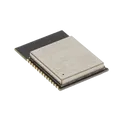
58 Uses0 StarsESP32-C6-WROOM-1-N8
802.15.4, Bluetooth, WiFi Bluetooth v5.0, Zigbee Transceiver Module 2.4GHz PCB Trace Surface Mount The ESP32-C6-WROOM-1-N8 integrates a 32-bit RISC-V single-core processor running up to 160 MHz, along with 8 MB of embedded SPI flash memory. It supports multiple wireless communication protocols, including: Wi-Fi 6 (802.11ax) in the 2.4 GHz band for improved efficiency and lower latency Bluetooth Low Energy (BLE 5) for short-range communication IEEE 802.15.4 for protocols such as Thread and Zigbee The module features a built-in PCB antenna, RF circuitry, crystal oscillator, and passive components, making it a complete solution that simplifies hardware design. It provides a wide range of GPIO pins and peripheral interfaces such as UART, SPI, I2C, PWM, ADC, and more, enabling flexible integration with sensors and external devices. Designed for low power consumption, it includes multiple power-saving modes, making it suitable for battery-powered applications. Typical Applications Smart home and IoT devices Wireless sensors and control systems Industrial automation Smart lighting and energy management Matter-compatible devices (via Thread support)
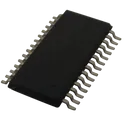
181 Uses0 StarsMCP3913A1T-E/SS
MCP3913 Series 3.6 V 4.5 mA SMT Six-Channel Analog Front End - SSOP-28 The MCP3913A1T-E/SS is a high-performance, multi-channel analog front-end (AFE) from Microchip Technology intended for precision measurement applications. It features six simultaneous sampling 24-bit delta-sigma ADCs with integrated programmable gain amplifiers, enabling accurate acquisition of low-level analog signals. Designed for energy monitoring and industrial sensing, the device provides low noise, high dynamic range, and flexible configuration. It supports SPI communication for efficient interfacing with microcontrollers and digital processing systems. Key Features Six simultaneous sampling 24-bit delta-sigma ADC channels Integrated programmable gain amplifiers per channel High signal-to-noise ratio and low distortion Programmable oversampling ratios for performance tuning Internal voltage reference with external reference option SPI-compatible digital interface Configurable data output formats and control registers Low power operation modes Electrical Characteristics Resolution: 24-bit Number of Channels: 6 Input Configuration: Differential Supply Voltage: 2.7V to 3.6V Operating Temperature Range: -40°C to +125°C Programmable Gain: Up to 32 V/V (typical) Reference Voltage: Internal or external selectable Functional Description The device integrates six high-resolution delta-sigma ADCs that sample input signals simultaneously, ensuring accurate phase and timing relationships across channels. Each input passes through a programmable gain stage, allowing optimization for different sensor levels. Analog signals are digitized using oversampling and digital filtering techniques to achieve high precision and noise reduction. Configuration is handled via internal registers, and data is transferred through an SPI interface. Package Information Package Type: SSOP Pin Count: 28 Mounting Type: Surface Mount Applications Energy metering Power monitoring systems Industrial automation Multi-channel data acquisition Sensor interfacing Smart grid systems Advantages High integration reduces external components Simultaneous sampling improves measurement accuracy High resolution supports precise signal analysis Flexible configuration for various system requirements #commonpartslibrary #integratedcircuit #powermanagement #energymetering
10 Uses0 StarsAP510BFA-CBR
RF System on a Chip - SoC Cortex-M55 250MHz, 2.5D GPU, 4MB MRAM, 3.75MB SRAM, BLE5.4, -20 to +70 C, BGA , 1.71 V to 2.2 V -20C ~ 70C ARM® Cortex®-M55 System On Chip (SOC) IC Apollo510B 250MHz The AP510BFA-CBR is an ultra-low-power MCU System-on-Chip (SoC) designed for advanced embedded and edge-AI applications. It belongs to the Apollo510B series and integrates a powerful ARM Cortex-M55 processor optimized for both performance and energy efficiency. It combines processing, memory, and multiple peripherals into a single BGA package, making it suitable for compact and power-sensitive designs. Key Characteristics Core: ARM Cortex-M55 Max CPU Speed: 250 MHz Architecture: MCU / SoC Flash Memory: 4 MB RAM: ~3.75 MB Connectivity: I2C, SPI, UART, USB Wireless Support: Bluetooth 5.4 (variant dependent) Package: 153-BGA (compact high-density package) Key Features Built on Ambiq’s ultra-low-power SPOT technology Designed for battery-powered and energy-sensitive devices High computational performance for edge AI and DSP workloads Integrated peripherals for embedded system development Typical Applications Wearables (smartwatches, fitness bands) Smart home and IoT devices Edge AI / machine learning nodes Industrial sensors and monitoring systems Wireless communication modules #CommonPartsLibrary #IntegratedCircuit #SoC #Apollo510B
2 Uses0 StarsSHT41-AD1B-R2
Board Mount Humidity Sensors Intermediate Humidity and Temperature Sensor Humidity, Temperature 0 ~ 100% RH I2C ±1.8% RH 4 s Surface Mount The SHT41-AD1B-R2 is a fully calibrated, low-power environmental sensor that measures relative humidity (RH) and temperature. It integrates sensing elements, signal processing, and a digital interface into a small surface-mount package, making it ideal for space-constrained designs. Key Features Sensor Type: Digital humidity and temperature sensor Interface: I²C (easy MCU integration) Supply Voltage: ~1.08 V to 3.6 V Humidity Accuracy: up to ±1.8% RH (typical) Temperature Accuracy: up to ±0.2 °C (typical) Response Time: Fast measurement and low latency Power Consumption: Ultra-low, suitable for battery devices Package: DFN (compact, ~1.5 × 1.5 mm) Factory Calibration: No external calibration required Functional Overview The sensor uses capacitive humidity sensing combined with a bandgap temperature sensor. Internal electronics convert these measurements into digital data via I²C, eliminating the need for external ADCs or complex signal conditioning. Design Advantages Small footprint for compact PCBs Low power consumption for IoT and portable devices High reliability with long-term stability Fast response time for real-time monitoring Simple integration with microcontrollers Typical Applications IoT and smart home devices HVAC and climate control systems Wearables and portable electronics Industrial monitoring systems Environmental data logging #CommonPartsLibrary #Sensors,-Transducer #Humidity #Moisture-Sensor #SHT4x
1.2k Uses0 Stars