Sensors
A sensor is a device that detects and measures a physical property or phenomenon, such as temperature, pressure, or motion. Sensors are used in a wide range of applications, including industrial automation, environmental monitoring, healthcare, and transportation. Flux.ai is the world's largest community-driven public library of sensors, with footprints, symbols, datasheets, and simulation models. Our extensive collection of sensors covers a variety of use cases and industries, making it easy to find the perfect sensor for your application. Whether you need a temperature sensor for HVAC systems, a pressure sensor for automotive applications, or a motion sensor for security systems, Flux.ai has you covered. Our comprehensive library of sensors is constantly updated with the latest and most innovative technologies, ensuring that you have access to the best sensors available. So, if you need a sensor for your next project, be sure to check out Flux.ai and take advantage of our extensive collection and expert support.
RP2040
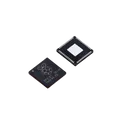
RP2040 chip for Raspberry Pi Pico - ARM® Cortex®-M0+ MCU 32-Bit The RP2040 is a high-performance, low-cost microcontroller built around two ARM Cortex-M0+ cores. It is optimized for flexibility, ease of use, and deterministic real-time performance. Unlike many microcontrollers, it includes a unique programmable I/O subsystem (PIO), allowing custom hardware interfaces without extra components. Key Features Processing Dual-core ARM Cortex-M0+ processors Up to 133 MHz clock speed Efficient integer performance with low power consumption Memory 264 KB on-chip SRAM External QSPI flash support (typically 2 MB–16 MB depending on board) Programmable I/O (PIO) 2 PIO blocks, each with 4 state machines Enables custom protocols (e.g., SPI, I2C, UART, WS2812, VGA, etc.) Offloads timing-critical tasks from CPU 🔗 Connectivity Interfaces 2× UART 2× SPI 2× I2C USB 1.1 controller (device or host support) 16× PWM channels Analog Features 12-bit ADC (up to 5 channels, including internal temperature sensor) Power & Voltage Operating voltage: 1.8V – 3.3V Low-power modes available Package Options QFN-56 (7×7 mm) Development Ecosystem Supports C/C++ SDK MicroPython and CircuitPython support Strong community and documentation Typical Applications Embedded systems and IoT devices Robotics and automation DIY electronics and prototyping USB devices (HID, MIDI, etc.) Custom communication interfaces using PIO #CommonPartsLibrary #IntegratedCircuit #Microcontroller
1.1k Uses12 StarsESP32-DEVKITC-32UE
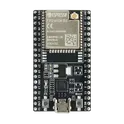
- ESP32-WROOM-32UE Transceiver; 802.11 b/g/n (Wi-Fi, WiFi, WLAN), Bluetooth® Smart Ready 4.x Dual Mode 2.4GHz Evaluation Board The ESP32-DEVKITC-32UE is a development board based on the ESP32 series SoC designed by Espressif. It is widely used for IoT, embedded systems, and wireless communication applications due to its built-in Wi-Fi and Bluetooth capabilities. Microcontroller: ESP32 dual-core Tensilica LX6 processor Wireless Connectivity: Wi-Fi (802.11 b/g/n) and Bluetooth (Classic + BLE) Flash Memory: Integrated SPI flash (varies by module version) Development Interface: USB-to-UART bridge for easy programming and debugging Power Supply: Typically powered via USB or external 5V input GPIO Pins: Multiple multifunction GPIOs supporting ADC, DAC, PWM, SPI, I2C, UART, etc. Supports deep sleep and ultra-low power modes Multiple peripheral interfaces (SPI, I2C, UART, SDMMC, PWM) Compatible with ESP-IDF, Arduino IDE, and MicroPython Built-in antenna (UE variant uses U.FL or external antenna option depending on module design) IoT devices and smart home systems Wireless sensor networks Data logging and monitoring systems Robotics and automation Embedded control systems #commonpartslibrary #developmentboard #esp32 #wroom
958 Uses7 Stars
Page 1 of 278
Next