Microcontrollers
A microcontroller is a small, low-cost computer-on-a-chip that can be used to control electronic devices and systems. It consists of a central processing unit (CPU), memory, input/output (I/O) ports, and other peripherals integrated onto a single chip. Microcontrollers are commonly used in a wide range of applications, including automotive systems, home appliances, industrial automation, and consumer electronics. One of the key benefits of microcontrollers is their ability to interact with their environment through sensors and actuators, making them well-suited for use in embedded systems. These systems are often found in devices that require real-time control or data processing, such as medical equipment, aircraft, and factory automation systems. Flux.ai is home to the world's largest community-driven public library of microcontrollers, with footprints, symbols, datasheets, and simulation models for a wide range of devices. Whether you're a professional engineer looking for a specific microcontroller for your next project, or a hobbyist exploring the possibilities of microcontroller-based systems, Flux.ai has the resources you need to get started.
ADXL335BCPZ-RL7
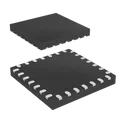
Accelerometer X, Y, Z Axis ±3g 1.6kHz (X,Y), 550Hz (Z) 16-LFCSP-LQ (4x4) The ADXL335BCPZ-RL7 is a low-power, complete 3-axis accelerometer with analog voltage outputs proportional to acceleration. It measures acceleration along the X, Y, and Z axes with a full-scale range of ±3 g. This device integrates a micro-electromechanical system (MEMS) sensor with signal conditioning circuitry, enabling direct analog output without the need for external amplification. The RL7 suffix indicates tape-and-reel packaging for automated assembly. The ADXL335BCPZ-RL7 is designed for compact, battery-powered, and motion-sensitive applications where low power consumption and ease of integration are critical. Functional Overview The accelerometer operates using a capacitive sensing structure. Acceleration causes displacement of an internal mass, changing capacitance, which is converted into a proportional analog voltage output. Each axis operates independently and provides a continuous analog signal that can be read by a microcontroller’s ADC. External capacitors allow the user to configure bandwidth per axis, enabling optimization for noise or response speed. Electrical Characteristics Supply Voltage Range: 1.8 V to 3.6 V Supply Current: Typical: 350 µA Measurement Range: ±3 g Sensitivity (Typical): 300 mV/g Zero-g Bias Level: Approximately VCC / 2 Bandwidth: Adjustable via external capacitors Typical limits: X, Y axes: up to 1600 Hz Z axis: up to 550 Hz Output Characteristics Output Type: Analog (ratiometric to supply voltage) Axes: Three independent outputs (XOUT, YOUT, ZOUT) Output Impedance: Approximately 32 kΩ Noise Density: X/Y axes: ~150 µg/√Hz Z axis: ~300 µg/√Hz Mechanical Characteristics Package Type: 16-lead LFCSP Package Dimensions: Approximately 4 mm × 4 mm × 1.45 mm Mounting: Surface mount Packaging Option: Tape and reel (RL7) Environmental Specifications Operating Temperature Range: −40°C to +85°C Storage Temperature Range: −65°C to +150°C Shock Survival: Up to 10,000 g Interface Requirements External Components: Capacitors required for bandwidth selection (one per axis) Interface Type: Analog voltage outputs compatible with ADC inputs Pin Description (Summary) ST: Self-test input XOUT: X-axis analog output YOUT: Y-axis analog output ZOUT: Z-axis analog output VCC: Power supply GND: Ground NC: No connection / reserved Applications Tilt and orientation sensing Motion and vibration detection Portable electronics Gaming controllers Wearable devices Industrial monitoring systems Key Features Three-axis acceleration measurement Low power consumption Analog output for simple interfacing Compact MEMS package Adjustable bandwidth Wide temperature operating range Tape-and-reel packaging for automated manufacturing #commonpartslibrary #integratedcircuit #sensor #accelerometer
2 Uses0 StarsSTM32F103C8T6
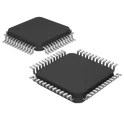
ARM® Cortex® M3 STM32F1 Microcontroller IC 32-Bit Single-Core 72MHz 64KB (64K x 8) FLASH Medium-density performance line Arm®-based 32-bit MCU with 64 or 128 KB Flash, USB, CAN, 7 timers, 2 ADCs, 9 com. interfaces Arm® 32-bit Cortex®-M3 CPU core – 72 MHz maximum frequency, 1.25 DMIPS/MHz (Dhrystone 2.1) performance at 0 wait state memory access – Single-cycle multiplication and hardware division • Memories – 64 or 128 Kbytes of Flash memory – 20 Kbytes of SRAM • Clock, reset and supply management – 2.0 to 3.6 V application supply and I/Os – POR, PDR, and programmable voltage detector (PVD) – 4 to 16 MHz crystal oscillator – Internal 8 MHz factory-trimmed RC – Internal 40 kHz RC – PLL for CPU clock – 32 kHz oscillator for RTC with calibration • Low-power – Sleep, Stop and Standby modes – VBAT supply for RTC and backup registers • 2x 12-bit, 1 µs A/D converters (up to 16 channels) – Conversion range: 0 to 3.6 V – Dual-sample and hold capability – Temperature sensor • DMA – 7-channel DMA controller – Peripherals supported: timers, ADC, SPIs, I 2Cs and USARTs • Up to 80 fast I/O ports – 26/37/51/80 I/Os, all mappable on 16 external interrupt vectors and almost all 5 V-tolerant Debug mode: – Serial wire debug (SWD) and JTAG interfaces • Seven timers – Three 16-bit timers, each with up to 4 IC/OC/PWM or pulse counter and quadrature (incremental) encoder input – 16-bit, motor control PWM timer with dead-time generation and emergency stop – Two watchdog timers (independent and window) – SysTick timer 24-bit downcounter • Up to nine communication interfaces – Up to two I2C interfaces (SMBus/PMBus®) – Up to three USARTs (ISO 7816 interface, LIN, IrDA capability, modem control) – Up to two SPIs (18 Mbit/s) – CAN interface (2.0B Active) – USB 2.0 full-speed interface • CRC calculation unit, 96-bit unique ID • Packages are ECOPACK #commonpartslibrary #integratedcircuit #microcontroller #stm32f1
36 Uses0 StarsLP2985IM5-2.7
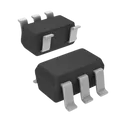
Linear Voltage Regulator IC Positive Fixed 1 Output 150mA SOT-23-5 LP2985IM5-2.7 is a low-dropout (LDO) linear voltage regulator designed to provide a stable 2.7 V output with very low quiescent current and excellent noise performance. It is optimized for battery-powered and noise-sensitive applications, offering high power supply rejection ratio (PSRR) and fast transient response. The device is housed in a compact SOT-23-5 package, making it ideal for space-constrained designs. Key Features Fixed 2.7 V output voltage Low dropout voltage Low quiescent current (IQ) High PSRR for noise-sensitive applications Stable with low ESR ceramic capacitors Thermal shutdown and current limit protection Small SOT-23-5 package RoHS compliant Electrical Characteristics Output Voltage: 2.7 V (fixed) Output Voltage Accuracy: ±1.5% (typical) Maximum Output Current: 150 mA Dropout Voltage: ~280 mV at 150 mA (typical) Quiescent Current (IQ): ~65 µA (typical) Line Regulation: 0.04%/V (typical) Load Regulation: 0.2% (typical) PSRR: Up to 70 dB (at low frequency) Operating Input Voltage Range: 2.5 V to 16 V Operating Temperature Range: -40°C to +125°C Mechanical Characteristics Package Type: SOT-23-5 (DBV) Mounting Type: Surface Mount Pin Count: 5 pins Approximate Dimensions: 2.9 mm × 1.6 mm Pin Configuration (Typical) IN: Input voltage GND: Ground OUT: Regulated output (2.7 V) EN: Enable (active high) BYPASS: Noise reduction / bypass capacitor connection Performance Characteristics Excellent output noise performance (low-noise design) Fast transient response to load changes Stable with small ceramic capacitors (typically 1 µF) Suitable for RF and analog circuits Applications Battery-powered devices Portable electronics RF and wireless modules Sensors and analog circuits Microcontroller power supplies #CommonPartsLibrary #IntegratedCircuit #PowerManagement #voltage-regulator #LDO #LP3985
2 Uses0 StarsKTD2027BEWE-TR
LED Lighting Driver ICs LED Lighting Drivers 4-Channel RGBW Driver, I2C, 1.5x1.5mm TDFN The KTD2027BEWE-TR is a highly integrated, low-power RGB LED driver designed for portable and battery-powered applications. It features a compact WLCSP package and provides precise current control for up to three LED channels. The device includes an I²C-compatible interface, enabling flexible control of brightness, color mixing, and lighting effects. Integrated features such as programmable current sinks, dimming control, and built-in protection mechanisms make it suitable for indicators, backlighting, and decorative lighting in consumer electronics. Key Features Triple-channel constant current LED driver (RGB support) I²C-compatible digital interface Independent brightness control per channel Programmable current up to ~24 mA per channel Built-in PWM dimming and pattern generation Low quiescent current for power-sensitive applications Wide input voltage range Thermal shutdown and overcurrent protection Small WLCSP package (suitable for compact designs) Applications Mobile devices and wearables Status indicators and notification LEDs Backlighting and decorative lighting IoT and portable electronics Absolute Maximum Ratings Supply Voltage (VDD): −0.3 V to +6.0 V Logic Input Voltage: −0.3 V to VDD + 0.3 V Operating Temperature Range: −40°C to +85°C Storage Temperature Range: −55°C to +150°C Recommended Operating Conditions Supply Voltage (VDD): 1.8 V to 5.5 V LED Forward Voltage: Dependent on external LEDs Ambient Temperature: −40°C to +85°C Electrical Characteristics (Typical) Supply Current (Idle): < 1 µA (shutdown mode) Channel Current Accuracy: ±5% (typical) Maximum Output Current: ~24 mA per channel I²C Clock Frequency: Up to 400 kHz (Fast Mode) Functional Description The KTD2027BEWE-TR operates as a constant-current sink driver for RGB LEDs. Each channel can be independently programmed via the I²C interface to control brightness and enable dynamic lighting effects. Internal PWM generators allow smooth dimming without requiring continuous microcontroller intervention. The device also integrates protection features such as thermal shutdown and current limiting to ensure reliable operation. Pin Configuration (Typical WLCSP) VDD – Power supply GND – Ground SDA – I²C data line SCL – I²C clock line LED1 – Current sink output (Red) LED2 – Current sink output (Green) LED3 – Current sink output (Blue) Package Information Package Type: WLCSP (Wafer-Level Chip Scale Package) Mounting: Surface mount Tape & Reel: Yes (TR suffix) Ordering Information KTD2027BEWE-TR: Tape and reel packaging for automated assembly #commonpartslibrary #integratedcircuit #leddriver
3 Uses0 StarsFL2500283Z
25 MHz ±30ppm Crystal 20pF 50 Ohms 4-SMD, No Lead The FL2500283Z is a 25 MHz surface-mount quartz crystal manufactured by Diodes Incorporated, part of the FL series (SaRonix-eCera™). It is designed for use as a stable clock reference in digital circuits such as microcontrollers, communication modules, and embedded systems. This crystal uses an AT-cut resonator inside a compact 3.2 mm × 2.5 mm (3225) ceramic package, making it suitable for high-density PCB designs and modern electronics. Key Features Standard Frequency 25 MHz fundamental mode crystal Compact SMD Package 3.2 × 2.5 mm (3225), 4-pad configuration Height ~0.68–0.75 mm AT-Cut Quartz Technology Provides good frequency stability and low drift Frequency Stability & Tolerance Typical: ±10 to ±30 ppm Load Capacitance Typically 20 pF Low ESR Around 50–60 Ω, suitable for MCU oscillator circuits Wide Operating Temperature Common range: -20°C to +70°C (some variants up to -40°C to +125°C) Surface-Mount Compatibility Ideal for automated assembly and reflow soldering RoHS / Lead-Free Environmentally compliant design Typical Applications Microcontroller clock (STM32, ESP32, AVR, etc.) Communication modules (Wi-Fi, Ethernet, RF) Embedded systems Consumer electronics Industrial control boards #Crystal #Oscillator #Resonator #SaRonix-eCera™ FL
105 Uses0 StarsPPPC082LJBN-RC
16 Position Header Connector 0.100" (2.54mm) Through Hole, Right Angle Gold The PPPC082LJBN-RC is a dual-row, right-angle pin header connector intended for through-hole PCB mounting. It uses a standard 2.54 mm pitch with a 2×8 pin configuration and is commonly used for board-to-board or board-to-cable connections. The connector provides stable mechanical support and reliable electrical performance, making it suitable for prototyping, embedded systems, and general-purpose electronic designs. Mechanical Specifications Connector Type: Pin Header Mounting Type: Through-Hole, Right Angle Number of Positions: 16 (2×8) Pitch: 2.54 mm Row Spacing: 2.54 mm Contact Orientation: Right Angle Termination Style: Solder Housing Material: Thermoplastic (UL94V-0 rated) Contact Material: Brass Electrical Specifications Current Rating: Typically up to 3 A per contact Voltage Rating: Typically 250 V Contact Resistance: ≤ 20 mΩ Insulation Resistance: ≥ 1000 MΩ Dielectric Withstanding Voltage: ~500 VAC Environmental Specifications Operating Temperature Range: -40°C to +105°C Flammability Rating: UL94V-0 RoHS Compliance: Yes Plating Contact Plating: Gold flash over nickel (typical) Tail Plating: Tin over nickel Applications PCB interconnections Embedded systems and microcontroller boards Industrial control interfaces Consumer electronics prototyping Signal and low-power connections Mating Compatibility Compatible with standard 2.54 mm pitch female headers and IDC connectors #commonpartslibrary #connector #header
15 Uses0 StarsESP32-C6FH4
IC RF TxRx Only Bluetooth, WiFi Bluetooth v5.0, Thread, Zigbee® 2.412GHz ~ 2.484GHz 32-VFQFN Exposed Pad The ESP32-C6FH4 is a low-power, highly integrated wireless microcontroller from Espressif Systems, designed for IoT applications. It is based on a 32-bit RISC-V processor running at up to 160 MHz, providing efficient performance for embedded systems while maintaining low power consumption. This variant includes 4 MB of embedded flash memory, making it suitable for standalone applications without the need for external flash. The ESP32-C6FH4 supports multiple wireless communication protocols, including: Wi-Fi 6 (802.11ax) in the 2.4 GHz band (backward compatible with Wi-Fi 4/802.11 b/g/n) Bluetooth Low Energy (BLE 5) IEEE 802.15.4 (used for protocols like Thread and Zigbee) Key features include: Rich set of GPIO pins with support for peripherals such as UART, SPI, I2C, PWM, ADC, and more Integrated hardware security features (secure boot, flash encryption, cryptographic accelerators) Multiple low-power modes for battery-operated devices On-chip temperature sensor and RTC peripherals #commonpartslibrary #transceiver
63 Uses0 StarsTSW-122-07-G-S
Connector Header Through Hole 22 position 0.100" (2.54mm) PinHeader_1x22_P2.54mm_Vertical General Description The TSW-122-07-G-S is a through-hole vertical pin header manufactured by Samtec. It is part of the TSW series, designed for board-to-board or wire-to-board interconnections. This component features a single-row configuration with standard 2.54 mm pitch spacing, making it widely compatible with common prototyping and production PCB designs. It is commonly used in embedded systems, development boards, and general-purpose electronic assemblies requiring reliable and cost-effective connectivity. Key Features Single-row vertical pin header Through-hole mounting style Standard 2.54 mm pitch spacing Tin-plated contacts for reliable electrical connection Black thermoplastic insulator housing Designed for board-to-board or cable interfacing Compatible with standard mating connectors and sockets Electrical Characteristics Current rating suitable for signal-level and low-power applications Contact resistance designed for stable electrical performance Insulation resistance suitable for typical PCB environments Mechanical Characteristics Number of positions: twenty-two Row configuration: single row Mounting type: through-hole Orientation: vertical Contact material: copper alloy Contact plating: tin Housing material: high-temperature thermoplastic Environmental Characteristics Operating temperature range suitable for industrial and commercial electronics RoHS compliant Designed for durability under normal handling and soldering conditions Applications Microcontroller and development boards Prototyping platforms Board-to-board interconnections Embedded systems General electronic assemblies #commonpartslibrary #connector #header
39 Uses0 StarsMCP3913A1T-E/SS
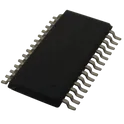
MCP3913 Series 3.6 V 4.5 mA SMT Six-Channel Analog Front End - SSOP-28 The MCP3913A1T-E/SS is a high-performance, multi-channel analog front-end (AFE) from Microchip Technology intended for precision measurement applications. It features six simultaneous sampling 24-bit delta-sigma ADCs with integrated programmable gain amplifiers, enabling accurate acquisition of low-level analog signals. Designed for energy monitoring and industrial sensing, the device provides low noise, high dynamic range, and flexible configuration. It supports SPI communication for efficient interfacing with microcontrollers and digital processing systems. Key Features Six simultaneous sampling 24-bit delta-sigma ADC channels Integrated programmable gain amplifiers per channel High signal-to-noise ratio and low distortion Programmable oversampling ratios for performance tuning Internal voltage reference with external reference option SPI-compatible digital interface Configurable data output formats and control registers Low power operation modes Electrical Characteristics Resolution: 24-bit Number of Channels: 6 Input Configuration: Differential Supply Voltage: 2.7V to 3.6V Operating Temperature Range: -40°C to +125°C Programmable Gain: Up to 32 V/V (typical) Reference Voltage: Internal or external selectable Functional Description The device integrates six high-resolution delta-sigma ADCs that sample input signals simultaneously, ensuring accurate phase and timing relationships across channels. Each input passes through a programmable gain stage, allowing optimization for different sensor levels. Analog signals are digitized using oversampling and digital filtering techniques to achieve high precision and noise reduction. Configuration is handled via internal registers, and data is transferred through an SPI interface. Package Information Package Type: SSOP Pin Count: 28 Mounting Type: Surface Mount Applications Energy metering Power monitoring systems Industrial automation Multi-channel data acquisition Sensor interfacing Smart grid systems Advantages High integration reduces external components Simultaneous sampling improves measurement accuracy High resolution supports precise signal analysis Flexible configuration for various system requirements #commonpartslibrary #integratedcircuit #powermanagement #energymetering
14 Uses0 Stars