Top User Projects
Explore innovation and practical design in Flux.ai's top user projects. This collection highlights outstanding printed circuit board (PCB) projects crafted by our community members. Featuring a range of complexities and applications, these projects showcase the real-world potential and diversity of PCB design. The top user projects section is an invaluable resource for inspiration and learning. Whether you’re a veteran PCB designer seeking fresh ideas or a newcomer aiming to understand various design strategies, these projects offer a wealth of knowledge and insight into the dynamic world of PCB design. By highlighting the achievements of our community, the top user projects stand as a testament to the innovative spirit and collaborative nature of Flux.ai’s users, fostering a culture of knowledge sharing and continuous advancement in the field of electronics design.
Guitar Pedal Template
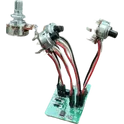
Guitar pedal starter template based on project by Mark Wu. Includes schematic and PCB layout for basic DIY pedal hardware. This includes two 1/4" jacks (one for input and one for output), a 9V power supply (including LED), a 3PDT true bypass wiring setup, and an example potentiometer that can be copy/pasted throughout the circuit. The headers are meant to be unpopulated so that wires can be soldered to the pads. PCB design rules imported from the JLCPCB 2-layer stackup template. #template
0 Uses1 StarsFrantic Plum Pip boy
como puedo corregir este codigo para que funcione en flux.io import time import random import matplotlib.pyplot as plt import io import base64 from fluxio import Flow flow = Flow() @flow.task def linear_search(arr, target): for i in range(len(arr)): if arr[i] == target: return i return -1 @flow.task def binary_search(arr, target): low = 0 high = len(arr) - 1 while low <= high: mid = (low + high) // 2 if arr[mid] == target: return mid elif arr[mid] < target: low = mid + 1 else: high = mid - 1 return -1 @flow.task def measure_time(func, arr, target): start_time = time.time() func(arr, target) end_time = time.time() return end_time - start_time @flow.task def generate_data_and_measure(): sizes = [100, 1000, 5000, 10000, 50000, 100000] linear_times = [] binary_times = [] for size in sizes: arr = random.sample(range(size * 2), size) target = random.choice(arr) sorted_arr = sorted(arr) linear_time = measure_time(linear_search, arr, target) binary_time = measure_time(binary_search, sorted_arr, target) linear_times.append(linear_time) binary_times.append(binary_time) return sizes, linear_times, binary_times @flow.task def plot_results(sizes, linear_times, binary_times): plt.plot(sizes, linear_times, label='Búsqueda Lineal') plt.plot(sizes, binary_times, label='Búsqueda Binaria') plt.xlabel('Tamaño del Array') plt.ylabel('Tiempo de Ejecución (segundos)') plt.title('Análisis de Complejidad Temporal') plt.legend() plt.grid(True) buf = io.BytesIO() plt.savefig(buf, format='png') buf.seek(0) img_str = base64.b64encode(buf.read()).decode('utf-8') plt.close() return img_str @flow.task def main(): sizes, linear_times, binary_times = generate_data_and_measure() img_str = plot_results(sizes, linear_times, binary_times) return img_str if __name__ == "__main__": flow.run(main)
0 Uses1 StarsOPA2863RUNR
The OPAx863 series from Texas Instruments includes the OPA863, OPA2863, and OPA4863, which are low-power, rail-to-rail input/output, voltage-feedback operational amplifiers designed for high-performance applications. These amplifiers feature a unity-gain bandwidth of 110 MHz, a gain-bandwidth product of 50 MHz, and a low quiescent current of 700 µA per channel. The devices operate across a wide supply voltage range of 2.7 V to 12.6 V, making them suitable for both portable and battery-powered systems. With a slew rate of 105 V/µs, 5.9 nV/√Hz input voltage noise, and exceptional harmonic distortion performance (-129 dBc HD2, -138 dBc HD3 at 20 kHz for 2 Vpp output), the OPAx863 is adept for driving SAR and ΔΣ ADCs, acting as ADC reference buffers, low-side current sensing, photodiode TIA interfaces, and other high-precision tasks. Additional features include overload power limiting, output short-circuit protection, and a power-down mode with minimal quiescent current, making the OPAx863 series a versatile and robust choice for applications requiring low power and high-precision analog performance. The series includes single, dual, and quad-channel configurations available in various surface-mount packages to fit different design requirements.
0 Uses1 StarsTUSB8041IRGCR
The TUSB8041 by Texas Instruments is a highly integrated four-port USB 3.0 hub controller designed to facilitate high-speed data transfers and power management in computer systems, docking stations, monitors, and set-top boxes. This component offers simultaneous SuperSpeed USB (5 Gbps), high-speed (480 Mbps), full-speed (12 Mbps), and low-speed (1.5 Mbps) data connections, ensuring backward compatibility with USB 2.0 and USB 1.x devices. Key features include multi-transaction translation with four transaction translators, asynchronous endpoint buffers for improved data management, and comprehensive battery charging support compliant with various standards including CDP, DCP, and Chinese Telecommunications Industry Standard YD/T 1591-2009. Flexible power management options are available, catering to both per-port and ganged power control configurations, alongside over-current protection mechanisms. The device also supports custom configurations via OTP ROM, serial EEPROM, or I2C/SMBus interfaces, enabling customization for vendor IDs, product IDs, port specifics, and string descriptors. Ease of integration is further enhanced with the ability for on-board and in-system OTP/EEPROM programming via the USB 2.0 upstream port, and the device requires no special drivers, operating seamlessly with any OS that supports USB. Packaged in a compact 64-pin QFN format, the TUSB8041 is offered in both commercial (0℃ to 70℃) and industrial temperature (-40℃ to 85℃) ranges, ensuring robust performance across diverse environmental conditions. With a single clock input requirement and comprehensive system resource support, the TUSB8041 is ideal for developers aiming to implement high-performance and reliable USB hubs in their designs.
0 Uses1 Stars