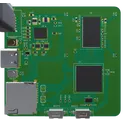
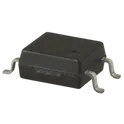
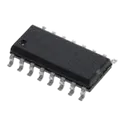
Top User Components
Discover the most popular and effective components used in cutting-edge PCB designs on Flux.ai. This collection showcases the components that have been integral to the success of our community's most innovative printed circuit board designs. Ranging from simple resistors to complex integrated circuits, these components represent the best in terms of functionality, reliability, and performance. It’s a treasure trove for anyone looking to enhance their PCB layout and designs with proven, high-quality components. It's an excellent resource for gaining insights into the component preferences of skilled designers and understanding why certain components stand out in the realm of electronic design. Whether you're refining your current project or starting a new one, these components offer valuable inspiration and a benchmark for quality. By spotlighting the components chosen by our top users, Flux.ai not only celebrates the ingenuity of its community but also fosters a culture of sharing and learning. This subcategory is a testament to the collaborative spirit at Flux.ai, encouraging continuous improvement and exploration in electronic component selection.
ThirstIQ Cap
High-level recreation of the ThirstIQ Cap wiring diagram using an ESP32-WROOM-32 with AMS1117-3.3 regulated battery input, inline ON/OFF switch, four touch input headers on IO32/IO33/IO25/IO26, shared I2C OLED and RTC on IO21/IO22, UART debug/programming header on TXD0/RXD0, BOOT and RESET pushbuttons on IO0 and EN, buzzer on IO4, common 3V3/GND distribution, and PCB preparation for a 160 mm x 100 mm 4-layer layout. Layout intent includes clean 3.3 V power distribution, local decoupling for regulator and ESP32, accessible external headers/buttons, short clean BOOT/EN traces, shared I2C routing, touch-signal separation from noisy power and buzzer traces, and ESP32 antenna keepout.
0 Uses1 StarsESP32-WROOM-32E Reference Design
This project involves designing a versatile IoT sensor hub using the ESP32-WROOM-32E module. The main objective is to create a platform that enables seamless data collection and transmission from various environmental sensors over a WiFi network. The device will feature USB-C for power and data transfer, and will utilize on-board voltage regulation to ensure stable operation. A CH340C chip is employed for USB to serial conversion, facilitating easy programming and communication with a host computer. Key Features: Wireless Connectivity: Leverage the ESP32's built-in WiFi capabilities for real-time data transmission to cloud-based platforms or local servers. USB-C Interface: Utilize a modern USB-C connector for power and data transfer, providing flexibility and future-proofing the design. On-board Voltage Regulation: Include an AMS1117-3.3 voltage regulator to maintain a stable 3.3V output from the USB input, protecting sensitive components. Support for Multiple Sensors: Integrate various GPIOs to connect multiple sensor types ( temperature, humidity, air quality ) (temperature, humidity, air quality) for comprehensive environmental monitoring. Expandability: Design with additional headers for future expansion, enabling users to customize and extend the hub's capabilities with additional sensors or modules. Applications: Smart Home Automation: Integrating with home systems to monitor and respond to environmental changes. Environmental Monitoring: Providing data for ecological studies or urban environment monitoring. Industrial IoT: Enhancing systems within a factory or industrial setting to track conditions in real-time. With this setup, the device aims to be a robust and adaptable piece of technology, suitable for hobbyists, researchers, and developers interested in the expanding world of IoT.
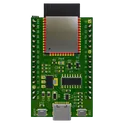
0 Uses1 StarsESP32 Robot Controller | AI Design Review Tutorial [Example]
Spot the mistake! Learn how to use AI to conduct a design review on an ESP32-based control board. This project is ideal for autonomous or radio-controller robots featuring inputs for sensors, encoders, and a Flysky RC receiver, plus an I2C display for configuration.
0 Uses1 StarsSwiftlane SRB Lite Relay Board
Swiftlane SRB Lite relay controller layout under production cleanup. Updated board-level rules to conservative manufacturable defaults (0.15 mm min trace and keep out, 0.25 mm board inset, explicit preferred widths) and audited remaining PCB blockers. Current blockers remain concentrated in overlapping copper, floating copper, and unrouted priority nets pending further interactive layout cleanup and re-route passes.
0 Uses1 Stars

![ESP32 Robot Controller | AI Design Review Tutorial [Example]](https://img-cdn.flux.ai/eyJidWNrZXQiOiJncmF2aXRvbi1lbGVjdHJpYy1zeW1ib2xzIiwia2V5IjoiZG9jdW1lbnRfYXNzZXRzL1RodW1ibmFpbC1FU1AzMi0tMS0tZTNjNjM0OGEtYjEzMy00YjliLWEyYTItMzY1MGNiMjgyYWJiLnBuZyIsImVkaXRzIjp7InJlc2l6ZSI6eyJ3aWR0aCI6MTI0LCJoZWlnaHQiOjEyNCwiZml0IjoiY29udGFpbiIsImJhY2tncm91bmQiOnsiciI6MCwiZyI6MCwiYiI6MCwiYWxwaGEiOjB9fX0sIm91dHB1dEZvcm1hdCI6IndlYnAifQ==)